
The Arts in Business · 65 min
On the Artist Leader
With Joan Mulvihill
On the artist mindset, originality and bringing humanity into organisations.
Explore the episodeA place to follow the inquiry as it develops.
Open the conversationWhen we listen closely. When we notice differently. When we move. When we think together.
Enter the inquiry ↓︎The question we’re holding
.beyondcomms explores this question through research, conversation and artistic practice. A place to develop ideas, deepen relationships, and discover what becomes possible when we are present with one another.
.beyondcomms brings research, strategic thinking and creative exploration together to help organisations navigate complex challenges and communicate with the people who matter to them.
Who we are, what we believe and where art meets business.
02 / ServicesCommunications, brand strategy, campaigns and new ways of thinking.
03 / ThinkingResearch, writing and conversations. Explore the ideas and bring your perspective.
04 / Our WorkSelected projects, from strategic direction to creative expression.
Whether you have a question, a project in mind or a possibility to explore, let’s start a conversation.
Connect with usThis research grows through exchange. Bring something you’ve noticed, experienced or wondered about, and help shape what we explore next.
It doesn’t need to be a finished idea.
A tension, a surprising connection, or a question about creativity, communication and how we work together.
A moment from your organisation or artistic practice. When did listening, noticing or creating together change what became possible?
A research perspective, a person to speak with, a piece of work to encounter, or an idea for collaboration.
Send us a few lines about what’s on your mind. A question, a voice note or a link is a welcome beginning.
Write to us hello@beyondcomms.ioArtistic sensibilities. Creativity in organisations.
With Joan Mulvihill
On the artist mindset, originality and bringing humanity into organisations.
Explore the episode
On intuition, artful knowing, and the knowledge organisations make room for.
Read the journal entryA question, an experience, a connection.
Bring your perspective to the inquiry.
How can artistic sensibilities change the way we work? Conversations with artists, entrepreneurs and people bringing the two worlds together.
2 February 2026 · 65 minWith Joan Mulvihill
Explore the episode 10 November 2025 · 72 min
With Fiona Delaney
Explore the episode 22 December 2022 · 55 min
With Noura Ali-Ramahi
Explore the episode 15 December 2022 · 36 min
With Lily Moinette
Explore the episode 8 December 2022 · 53 min
With Salvatore Lavallo
Explore the episode 1 December 2022 · 38 min
With Alexa Mena
Explore the episode 24 November 2022 · 55 min
With Brian Patrick Murphy
Explore the episode 17 November 2022 · 50 min
With Omar Shoukri
Explore the episode 10 November 2022 · 60 min
With Michael Littig
Explore the episode 3 November 2022 · 54 min
With Hennie Ward
Explore the episodeWriting on purpose, creativity and the ways organisations communicate. Including the earlier A Shot of Purpose newsletter archive.
When was the last time you listened to your surroundings? What does the world sound like when you open your window in the…
Read the piece 8 January 2025 · 4 min readThis interview features Sebastian’s conversation with Laura Avonius, Founder & CEO of Audicin. As part of our ongoing informal research into the impact and significance of purpose,…
Read the piece 30 October 2024 · 5 min readWhether it is a fully articulated statement or an amorphous feeling that pulls us into a direction, we know that purpose increases our quality of life, mood and drive. Businesses are…
Read the piece 22 October 2024 · 6 min readIf you wanted to know about the impact of a purpose for a business, you’d be disappointed with the amount of data and insights you can find. We have set out to find executives and business…
Read the piece 7 October 2024 · 4 min readUncovering and articulating your purpose is a foundational element in building your personal brand. I’m September 30, 2024 our founder, Sebastian, sat down with the Co-Chairs of the…
Read the pieceYesterday I sat staring at a blank page for forty minutes. The cursor blinked. I had thoughts, fragments, half-formed insights about leadership and creativity swirling around, but nothing…
Read the piece 10 August 2025 · 5 min readMy family's bakery survived Hitler, Stalin, and the collapse of East Germany. It couldn't survive the…
Read the piece 3 August 2025 · 4 min readWe were sitting in the dark conference room at the other corner of campus. Four people stared at the whiteboard. The fifth person in the room, the PR consultant, spoke animatedly about the…
Read the piece 27 July 2025 · 4 min readI had my manager's wholehearted support for a promotion request. They promised to fight for it, assured me it would happen. But for months, nothing moved. When it finally came through, it…
Read the piece 20 July 2025 · 5 min readStuck with shame about money, fear of commitment, or chasing shiny objects, these leaders build businesses that plateau. This is not to say that mediocrity is bad, but I know that you are…
Read the piece 13 July 2025 · 4 min readWe are a little over halfway through 2025. I'm writing this week's issue during my period of strategic reflection. As someone who helps founders create clarity in their communications, I've…
Read the piece 6 July 2025 · 4 min readLast year, I watched a founder spend five figures on a brand recognition campaign that generated thousands of impressions but zero meaningful connections. The visuals were polished, the…
Read the piece 29 June 2025 · 4 min readLet's be honest - most mission statements suck. They might sound great and make us feel warm and fuzzy, but when looking at the day-to-day, they are nothing but a few nice words on a…
Read the piece 22 June 2025 · 3 min readHow do you know whom to trust anymore? AI-generated content is rampant on our social feeds and search engines. Midjourney and OpenAI are entangled in intellectual property rights battles…
Read the piece 12 June 2025 · 4 min readLast week, I had the pleasure of chatting with Kristen Holley on a LinkedIn Live. Kristen is an accomplished professional who works with companies on change…
Read the piece 8 June 2025 · 5 min readThat's how a recent sales call started for one of my clients - a legal services firm specializing in high-net-worth individuals. Not with the usual "Tell me about your company" or "What…
Read the piece 1 June 2025 · 5 min readNot her music specifically, but her journey. She is well known for her ability to mimic other celebrities like Celine Dion and Britney Spears - studying their techniques, copying their…
Read the piece 25 May 2025 · 4 min readPicture this: You're a founder with a brilliant idea that has the potential to change the world. You know what you want to do. You have a product or service already and are making decent…
Read the piece 18 May 2025 · 4 min readWhen we talk about purpose-driven companies, the same names often dominate the conversation – Patagonia, TOMS, Cadbury. While these corporate giants deserve a little recognition, they often…
Read the piece 11 May 2025 · 4 min readAfter a relatively calm start to the year, all hell seems to have broken loose over the last few weeks. May tends to be a busy time of the year - launches, conferences, personal events,…
Read the piece 24 April 2025 · 4 min readYou hear this with entrepreneurs all the time - we want to stay agile and lean. From a management perspective, that's great. But this often seeps into how businesses approach their…
Read the piece 20 April 2025 · 2 min readHappy Easter Sunday! The air this morning was filled with the sweet smells of blossoming flowers and the greens around us are intensifying. Spring is coming, and the Easter season rings in…
Read the piece 10 April 2025 · 4 min readI have been talking to several founders who are incredibly excited about building their products or services. They draw excitement from hunkering down writing code or looking at how to…
Read the piece 3 April 2025 · 5 min readI sang in an opera last week in Ireland's largest national theatre. As I was looking onto the stage from the wings, I kept reflecting on the great power that lies in operatic training.…
Read the piece 27 March 2025 · 5 min readWhen did you last feel creative? What does that mean to you? Creativity is an elusive little word. For some, it sits firmly in the space of artists, creators, and designers, for others, it…
Read the piece 20 March 2025 · 6 min readLast year, I was on my final call with a client, ready to present the brand story we had crafted. After I finished reading the story to them - silence. It was dreadful! When I switched back…
Read the piece 13 March 2025 · 4 min readToday's markets are noisy and crowded; there's no doubt about it. Some businesses try to shout over the masses, while others whisper to their neighbors, building small circles of influence.…
Read the piece 6 March 2025 · 4 min readIn the brand strategy and communications world, 'purpose for companies' is going out of fashion. There is enough evidence supporting the idea that purpose-driven campaigns are ineffective…
Read the piece 27 February 2025 · 3 min readThe theme of today's 'shot' has come up often in my calls with founders over the past weeks. Many have started their ventures. As they look to grow their business, they want their companies…
Read the piece 19 February 2025 · 2 min readThis week we're looking at something every founder struggles with: the weight of all that you 'should' be doing in your…
Read the piece 5 February 2025 · 3 min readOver the weekend, I finished a book that begins to upend the foundation .beyondcomms is built on. The title? The Road to Hell: How Purposeful Business Leads to Bad Marketing and a Worse…
Read the piece 28 January 2025 · 3 min readTwo weeks ago, we explored how deep listening creates the foundation for purpose work. Today, we'll dive into the next crucial step: Defining your business…
Read the piece 21 January 2025 · 3 min readLast week I asked founders on LinkedIn about their priorities for 2025. The response was clear: business strategy clarity topped the list. If you're nodding along, you're not alone – and…
Read the piece 14 January 2025 · 4 min readWhen was the last time you listened to your surroundings? What does the world sound like when you open your window in the…
Read the piece 7 January 2025 · 5 min readWelcome back and a Happy New Year! This week's edition features my conversation with Laura Avonius, Founder & CEO of Audicin. As part of our ongoing informal research into the impact and…
Read the piece 3 December 2024 · 2 min readWelcome back! Last week, we took the first step on our purpose journey by looking inward. Those foundational questions you answered? They're about to become even more powerful as we explore…
Read the piece 26 November 2024 · 2 min readWelcome to the first edition of A Shot of Purpose! We are excited to bring a little injection of purpose into your inbox each week. We'll explore how purpose can move businesses to connection,…
Read the pieceBring a question, a different perspective, or an interest in exploring these ideas in your organisation.
Prefer email? hello@beyondcomms.ioA Shot of Purpose · Entry 2
If we are to understand curiosity as a refusal of power structures and entrenched ways of doing and knowing, what does that reveal about how we know and what we do?
As I continue to explore the effects of curiosity, I think back to the beginning of my career. A fresh graduate with limited working experience, I sat in front of leaders with feelings and intuitions. When I was asked to contribute to strategies, I spoke not from a place of objective and factual knowing, but from a place of intuition. Countless times I was shut down, only to be proven correct a few weeks or months later. Asking questions out of curiosity was tolerated, but adding language to the sacred process of sense-making was often rejected. Only now do I begin to realize that this wasn’t about inexperience but about which kinds of knowing were allowed to speak.
There is a plane that we work on in the arts which exists between observation and sense-making. A space that evades language but is rich with knowledge. Thanks to Joan Mulvihill’s thought leadership, I encountered Dr. Chris Seeley’s work, who coined the idea of artful knowing – language that describes this liminal space.
Seeley talks about ‘Artful Organizations’ and ‘Artful Knowing’, concepts that embrace alternative ways of knowing. Her ideas are rooted in Heron & Reason’s work which divides the knowing into four different categories: experiential, presentational, propositional and practical. Art happens when we make sense of experiences through intuition, poetry, physical embodiment, and other non-propositional ways of knowing. For example, an actor will know when a moment is right without needing to name it or a leader will feel that the team is misaligned before data confirms it.
Our knowledge primarily rests on the propositional and practical plane – theories, concept, guides, spreadsheets, data, and step-by-step instructions guide our decision-making and strategies. Leadership often rejects someone’s opinion if they are not grounded in so-called facts and hard data. While there is merit to wanting to back up a strategy with facts and figures, we are excluding a significant portion of our working population.
An executive with 30+ years of experience will have built up a store of knowledge, inklings, and pattern recognition that can’t easily be explained by hard data. They will describe a ‘gut feeling’ that led them to a conclusion. When was the last time “gut” was celebrated in business – not as instinct alone, but as accumulated, embodied expertise?
Curiosity cuts beneath the spreadsheets and data to reveal the underlying assumptions and entrenched ways of knowing. I wonder if following curiosity and presentational knowing is one of the keys to unlocking innovation and more human business practices.
The problem is not that artful knowing is unreliable, but that it is politically inconvenient.
The wondrous aspect about experiencing art is that there is no right or wrong way to interpret a piece. However an audience member receives and perceives an artwork, piece of music, or play is the right way for them. There is complexity and depth when an artist doesn’t overexplain the piece.
This complexity in business is flattened by hierarchies and the prioritization of propositional and practical knowing. When we prioritize this way of being, we exclude the juniors who have inklings and feelings free from years of conditioning and seniors who are experienced enough to have gut feelings, yet are often discouraged from voicing them.
Our ancestors had amazing abilities to retain stories, transmit oral narratives and histories. Frances A. Yates wrote about these abilities in her work The Art of Memory. She describes a level of imagination and focus our ancestors had to build memory palaces and situate characters in vast imaginary spaces to draw from them when relaying the wisdom of times passed. She traces the decline of these practices throughout history to the dawn of the printing press and beginning of industrialization.
We have outsourced this incredible ability of imagination in our age of hyperproductivity. Now we give our thoughts to AI and note apps to free up mental capacity to draw out even more information and add language to our experiences that everyone can understand. The fight to get back in touch with our intuition will become an uphill battle.
Can we learn from artists’ way of sense-making and embracing knowledge to live more curiously in our businesses and drive innovation?
I see these dynamics in small teams and moments between managers and managed, or personal conversations before the board meeting when a leader can be approached and convinced. But rarely do these dynamics seem to play out in the larger context of a business.
What might become possible if we trusted ways of knowing before language arrives?
With curiosity,
Sebastian
PS: This research practice is ongoing and you can find the resources that have inspired this entry below. If there are any types of sources that come to your mind as you read, please share them. All is welcome, from recordings, poems, and fragments, to fully fledged podcasts, books, and journals.
Seeley, Chris with Thornhill, Ellen.
Artful Knowing and Artful Organizations. 2014.
(Referenced in relation to alternative ways of knowing in organizations, particularly presentational and artistic forms of sense-making that operate beyond propositional and practical knowledge.)
Mulvihill, Joan.
Conversation on The Arts in Business podcast with Sebastian Grube.
(Referenced as the point of introduction to Chris Seeley’s work and as a source of ongoing inquiry into creativity, leadership, and the intersection of arts and business.)
Heron, John & Reason, Peter.
A Participatory Inquiry Paradigm. Qualitative Inquiry, 3(3), 1997; and related writings on cooperative inquiry.
(Referenced for the framework of four ways of knowing: experiential, presentational, propositional, and practical.)
Yates, Frances A.
The Art of Memory. Routledge & Kegan Paul, 1966.
(Referenced in relation to pre-modern memory practices, imagination, and non-textual ways of organizing and transmitting knowledge.)
A question, a connection, an experience.
Bring your perspective to the inquiry.
A Shot of Purpose · Entry 1
As I continue to practice and work in communications, I feel that my clients and peers are inundated with ‘how-to-guides’, best practices, and all the hacks and strategies we are supposed to follow. Instead of offering yet another weekly “this is what you SHOULD do,” I am repositioning “A Shot of Purpose” to a research journal of bi-weekly reflections on business, communications, and being human. I hope that the questions that are emerging through my research and work will lead to some new insights and avenues of inquiry for you.
To me, this work is fundamental to practicing different ways of thinking and knowing that will lead to groundbreaking strategies and build world-leading brands.
For this first entry, we will focus on curiosity - not as a strategy.
Curiosity is one of my personal core values and an important anchor for the work we do at .beyondcomms. In every aspect of my work and life, I strive to lead with curious inquiry and exploration.
The birth of my son a few months ago has brought the importance of curiosity into sharp focus again. There has been a lot to learn about him, myself, and how my relationships change and evolve.
Across my recent listening, reading, and observation, I have been coming across curiosity, not as a personality trait or value, but as a way of being with uncertainty.
Clarity doesn’t arrive through force or urgency, but through curious companionship. We don’t think our way into meaning alone - we breathe our way into it, together.
This suggestion feels very much at odds with how modern businesses operate. I notice how we often fetishize passion, speed, money, and time.
Clarity becomes something that we extract, rather than letting it emerge by staying in the process long enough.
Elizabeth Gilbert’s podcast episode on On Being reminded me that perhaps the most radical practice is gentle, democratic, non-coercive curiosity.
When I scroll through my social media feeds, the fetishization of urgency, answers, data, and quick fixes practically screams in my face. I can’t help feeling rushed and behind in this era of hypercapitalism, when I see others value how much money they can make in the shortest amount of time.
I am inundated with explanations on how to break into lucrative niches, calls to focus my attention on only one or two speciality fields, and guides on how to optimize my life and schedule to the second.
When reading Lugones Coloniality and Gender, I couldn’t help but draw parallels to how much we dissociate in business. It’s unsettling to read just how much colonialisation altered existing structures and suppressed change, simply through acts of classification and quantification. Are we not doing the same in business every day - quantify, categorize, and analyse profit and loss sheets, performance, and schedules to make seemingly “better” (or perhaps more profitable) decisions?
In large corporations, departments are niches, reports provide the basis for strategy, and entire consulting companies are dedicated to optimizing performance, profits, and reputation.
For entrepreneurs building a business, the “name of the game” is often how fast can you scale and raise or make money to keep growing. Leadership in both cases often focuses on creating strategies that are quantifiable, measurable, and can be achieved in the shortest amount of time.
I have fallen prey to this in my own work, valuing control and certainty over clarity and companionship. There are economic realities we all have to live with. However, I wonder:
If we were to embrace the quiet and welcoming spirit of curiosity, could we not create or alter businesses to embrace the sense of wonder, discovery, and innovation that comes with pursuing a path that might not yet be fully illuminated?
Would a curious employee who seeks, questions, and observes not have a higher potential for ground-breaking innovation than a passionate one who relentlessly pursues one path?
Embracing the uncertainty that comes with curiosity can be scary, there is no doubt. It’s a big leap to take for leadership in a business. Is it worth it though if what lays behind the curious path is connection, companionship, and new opportunities?
I am left wondering whether curiosity is not a precursor to strategy or a strategy in itself, but rather a refusal of power structures and entrenched ways of doing and knowing – and perhaps that’s the more responsible place to start.
With curiosity,
Sebastian
PS: This research practice is ongoing and you can find the resources that have inspired this entry below. If there are any types of sources that come to your mind as you read, please share them. All is welcome, from recordings, poems, and fragments, to fully fledged podcasts, books, and journals.
If you have questions or suggestions, please reply to this email! If you know of someone who might enjoy this content, share A Shot of Purpose with them.
Sources:
Akomolafe, Bayo.
On Grief, Failure, and Staying with the Trouble. Podcast conversation.
(Referenced through ideas of curiosity, companionship, refusal of urgency, and non-coercive ways of knowing.)
Gilbert, Elizabeth.
Choosing Curiosity Over Fear. Interview on On Being with Krista Tippett.
(Referenced in relation to curiosity as a gentle, democratic, non-coercive practice.)
https://onbeing.org/programs/elizabeth-gilbert-choosing-curiosity-over-fear-may2018/
Lugones, María.
Coloniality and Gender. Hypatia, 22(1), 2008.
(Referenced in relation to classification, quantification, and imposed systems of knowing.)
A question, a connection, an experience.
Bring your perspective to the inquiry.
In this conversation, Joan Mulvihill shares her journey from corporate life to embracing her identity as an artist and leader. She discusses the importance of finding purpose, the artist mindset, and the need for originality in a world dominated by mechanistic thinking. Joan emphasizes the significance of vulnerability, creativity, and the necessity of rehumanizing organizations to foster a more innovative and fulfilling work environment. She advocates for a future where creativity and purpose drive societal progress, challenging the status quo of productivity and profit-driven motives.
Takeaways:
Learn more about Joan: https://www.linkedin.com/in/joanmulvihill/
During the episode, we referred to:
Dr. Chris Seeley: https://www.scribd.com/document/606612963/Artful-organisations-Dr-Chris-Seeley
John Ruskin: https://en.wikipedia.org/wiki/John_Ruskin
Eileen Gray: https://en.wikipedia.org/wiki/Eileen_Gray
Music by: Coma-Media (https://pixabay.com/users/coma-media)
Chapters
00:00 Introduction to Joan Mulvihill 01:02 Finding Purpose in Adversity 03:24 The Artist's Journey 08:51 Connecting Mindset and Making 11:30 Permission to Be an Artist 14:42 The Artist Mindset Defined 16:07 The Importance of Reflection 18:40 Embracing Vulnerability in Art 21:05 Creating Space for Originality 27:02 The Role of Nothingness 30:59 Trusting Yourself in Corporate Environments 33:10 Rehumanizing Organizations 33:15 The Human-Machine Dichotomy 37:43 Creativity and Purpose in Organizations 38:29 Embracing Uncertainty 42:28 The Artist Mindset 47:03 Rethinking Organizational Structures 50:20 The Future of Work and Society 57:00 The Call for Artist Leaders
In this engaging conversation, Fiona Delaney shares her journey from the arts to technology, exploring the intersections of creativity, empathy, and innovation. She discusses the impact of the financial crisis on her career, the importance of community in both the arts and tech sectors, and the role of diversity in creating human-centric solutions. Fiona emphasizes the significance of struggle in the creative process and the need for artists and technologists to connect with their audiences. The discussion culminates in reflections on legacy and the future of art and technology.
Takeaways
Learn more about Fiona: https://www.linkedin.com/in/fgdelaney/
During the episode, we referred to:
Paula Meehan: https://www.dedaluspress.com/authors/meehan-paula/
Patrick Kavanagh: https://en.wikipedia.org/wiki/Patrick_Kavanagh
Dermot Bolger: http://dermotbolger.com/
Music by: Coma-Media (https://pixabay.com/users/coma-media)
Chapters
00:00 Introduction to Fiona Delaney and Her Journey 04:49 The Intersection of Arts and Activism 09:41 Influences and Inspirations in Fiona's Artistic Life 14:45 The Role of Empathy in Music and Performance 19:41 Transitioning from Arts to Technology 24:16 Navigating the Financial Crisis and Its Impact 29:12 Exploring Blockchain and Technology 38:22 Embracing Decentralized Finance and Innovation 41:13 Exploring European Funding and Blockchain Opportunities 44:59 The Intersection of Art and Technology 49:48 The Power of Words and Identity 59:44 Navigating Digital Transformation and Community Building 01:07:02 The Role of Emotion in Creativity and Technology
In this episode we speak with Emirati artist Noura Ali-Ramahi. Noura is a prolific artists and also works as a learning and development professional. During our conversation, we cover her ritual of a daily walk, achieving a state of flow, and how bringing your artistic sensibilities into your professional role can open new conversations with your colleagues and clients.
Learn more about Noura on Instagram: https://www.instagram.com/nouraramahi/
During the episode, we referred to:
Mohamed Ahmed Ibrahim: Between Sunrise and Sunset: Works 1986–2022: https://www.amazon.com/Mohamed-Ahmed-Ibrahim-Between-1986-2022/dp/6148035448
Written by Rana Asfour: https://themarkaz.org/abu-dhabi-shows-noura-ali-ramahis-allow-me-not-to-explain/
Music by: Coma-Media (https://pixabay.com/users/coma-media)
Episode Overview:
(00:40) Introducing Noura
(01:50) Moment of Comfort
(02:48) Noura’s journey into the arts
(04:43) Investigating the Definition of ‘artist’
(07:48) Noura’s definition of artistic sensibilities
(12:10) Diving into gazing deeply and living again
(21:09) Consciously not labeling and not filtering
(25:04) Noura’s work in Learning and Development
(26:13) Bringing the arts into the workplace
(32:14) A state of flow (in a professional setting)
(39:06) Nourishing artistic sensibilities – making connections
(42:08) Making Connections and the three Ps
(47:28) Creating spaces where people can take risks
(53:25) Keep feeding curiosity
With Lily Moinette
Together with Lily Moinette, we explored how an artistic practice that is not based on professional pursuits can impact her work and community. Lily works as a Grants Coordinator for NYU Abu Dhabi where she helps faculty find the right funding opportunities for their research goals. When she is not working, Lily paints, sews, and hosts.
Episode Overview:
(00:40) – Introducing Lily
(01:41) – Moment of Comfort
(02:37) – Lily’s artistic practice
(03:50) – Feeling yourself through the mess
(04:56) – Lily’s definition of artistic sensibilities
(06:37) – On crafter-noons
(09:22) – Building in time for artistic endeavors
(10:20) – Lily’s work as grants coordinator
(12:14) – Connecting artistic sensibilities and finances
(14:14) – Problem-solving and working within constraints
(16:53) – Transitioning from Art History to Finance
(19:26) – Letting the materials guide you
(22:19) – Bringing the arts into excel spreadsheets
(25:50) – leaning into flexibility and adaptability
(28:43) – Finding the intersection between artistic sensibilities and professional work
(30:25) – Bringing the arts into corporate environments
(32:00) – How to create spaces for dialogue and discussion
(33:48) – Lily’s next milestones and intentions
In this episode Salvatore explores how his background and practice of dance intersects with his work in direct foreign investment. We speak about dance bringing joy to people, allowing for connection and how the intuitive sensibilities can lead to great negotiations.
Learn more about Salvatore on...
Instagram: https://www.instagram.com/sallavallo/
YouTube: https://www.youtube.com/c/SalLavallo193?app=desktop
LinkedIn: https://www.linkedin.com/in/salvatore-lavallo-bb58771a/
Episode Overview
(00:40) Introducing Salvatore Lavallo
(02:15) Moment of Comfort
(05:14) Salvatore’s background in dance
(10:00) Dance is the most basic form of expression of human happiness
(15:30) Encouraging others to dance
(17:45) Salvatore’s definition of artistic sensibilities
(20:45) Connecting Financial Investment and Dance
(23:03) Salvatore’s work as Head of FDI
(24:20) Bringing empathy into the workplace
(28:40) Uncovering empathy in the office
(32:05) Dance as a reflection of our societal norms
(35:21) Focusing on where we get joy from
(40:49) Heightening self-confidence through art
(43:58) Leaving space for reflection/feedback in the corporate world
(47:07) Getting back to dance
(50:46) Salvatore’s Milestones and intentions
In this episode we explore the collaboration and how it relates to the arts and corporate environments with Alexa Mena. Alexa is the Senior Project Manager and Business Development Specialist at Syndication Bureau Media Services.
Find Alexa on Instagram: https://www.instagram.com/ramenagirl/
Read 'The Overstory' by Richard Powers: https://www.amazon.com/Overstory-Novel-Richard-Powers/dp/039335668X
Read more about collaboration in Sebastian Grube's article 'Collaboration is Inevitable': https://open.substack.com/pub/sebastiangrube/p/collaboration-is-inevitable?r=i1owg&utm_campaign=post&utm_medium=web
Episode Overview:
(1:20) Introducing Alexa
(2:20) Moment of Comfort
(3:05) Alexa’s personal artistic practice – Listening and Responding
(4:58) Nurturing her artistic practice
(7:03) Alexa’s definition of artistic sensibilities
(8:05) Diversifying consumption
(12:24) On collaboration and defining collaboration
(16:21) Digging into collaboration and the inputs
(22:06) Redefining the concept of collaboration to response
(23:34) Alexa’s professional practice with Syndication Bureau Media Services
(25:01) Where do Alexa’s artistic sensibilities intersect with her professional practice
(26:54) Collaboration in Business Development
(29:34) Collaboration as a Response in business (32:46) Leveraging artistic sensibilities in one’s professional practice
(35:27) Alexa’s upcoming milestones
With Brian Patrick Murphy
In this episode, Brian speaks about the wealth of sensibilities that an arts practice brings with it. We also cover how to embrace the grey and Brian's move from the arts to business.
Subscribe to Brian's blog: https://brianpatrickmurphy.substack.com
Learn more about Brian on LinkedIn https://www.linkedin.com/in/brian-patrick-murphy-b14106179/
Discover Steven Pressfield's The War of Art: https://www.amazon.com/War-Art-Through-Creative-Battles/dp/1936891026/
Bonus! Watch Brian in the music Video 'Giddy On Up': https://www.youtube.com/watch?v=3xfFbB2CRo8
Episode Overview:
(1:20) Introducing Brian
(3:18) From acting to business
(5:25) Connecting an MBA and the Arts - Sebastian
(7:05) Finding the bridge between Arts and Business
(9:02) An educator at heart
(10:39) Moment of Comfort
(12:00) Brian’s Definition of Artistic Sensibilities
(14:35) Are definitions important?
(20:10) Brian’s journey from acting to business
(27:14) The sensibilities Brian found through his artistic practice
(29:43) On structure and habits
(34:45) Overcoming Resistance
(38:52) Take Action – It’s never too late
(41:34) Comparison is the thief of joy
(44:23) Resilience
(46:36) If you’re a bodybuilder, do Yoga. If you’re a yogi, do bodybuilding
(49:58) Brian’s milestones
With Omar Shoukri
Together with Omar Shoukri we dive into exploring how artistic sensibilities can begin to break down or change systematic and rigid environments that are often found in federal authorities and the corporate world. Omar is a learning & development expert, media producer and leadership coach.
Learn more about Omar on his website: https://omarshoukri.com/
Reach out to Omar via LinekdIn: https://www.linkedin.com/in/omarshoukri/
Episode Overview:
(1:20) Introducing Omar
(2:30) Moment of comfort
(3:16) Omar’s definition of artistic sensibilities
(7:05) The power of Lego and play
(10:18) Meet them where they are; add vulnerability; get to the core
(16:41) Bringing the arts into corporate environments
(21:45) Artistic sensibilities in different cultures
(28:00) Rediscovering the inner child
(35:15) Omar’s role at BBW
(43:18) The connections between IT and the Arts
(46:00) Living in the age of reiterations
(47:12) Creating a school and courses
With Michael Littig
In this episode, listeners will learn more about how Michael Littig embraces both the arts and business. We are diving into questions such as how to bring your whole self to what you do, and how to find the 'thing' that excites you to get out of bed in the morning.
Learn more about Michael: https://www.linkedin.com/in/michael-littignyc/
Learn more about THE HUG: https://thehug.xyz/
The first episode of The Arts in Business features Hennie Ward, UX Content Strategist at Huspy. Listen to Hennie to discover how her background in creative writing and theater informs her work as content strategist for an up-and-coming property technology firm.
Connect with Hennie on LinkedIn: https://www.linkedin.com/in/henrietta-w/.
Music by: Coma-Media (https://pixabay.com/users/coma-media)
Sometimes the challenge is finding the right words. Sometimes it's understanding what needs to be said in the first place. And sometimes, what's needed is a different way of looking at the problem altogether.
.beyondcomms brings research, strategic thinking and creative exploration together to help organisations navigate these challenges.
When your business operates in a specialist field, communicating its value to different audiences isn't always straightforward.
We help you understand the people you need to reach, identify what matters to them and develop clear, considered communications. From audience research and messaging to strategic communications planning, we make expertise more accessible without losing its depth.
Businesses evolve. Markets change. Sometimes the brand that brought you here no longer reflects where you're going.
We explore your organisation, its audiences and competitive environment to uncover what makes it distinct. Through positioning, narrative development and brand direction, we create a foundation for how your business presents itself to the world.
Whether you're launching something new, entering a market or looking to challenge established conventions, important ideas deserve thoughtful expression.
We combine audience insights, communications planning and creative thinking to develop campaigns that stand out for the right reasons. From initial concept to creative direction, we help turn strategic intentions into communications that connect.
An emerging area of our practice.
Sometimes progress requires stepping away from familiar ways of working and making room for different perspectives.
We're exploring how artistic practices, facilitated experiences and creative inquiry can help leadership teams navigate complexity, challenge assumptions and develop shared understanding.
This work is being developed through experimental workshops and leadership retreat prototypes.
Good communication isn't always about saying more. Sometimes, it begins by creating space to listen, understand and see things differently.
Our approach brings together research, communications expertise and artistic perspectives to explore challenges, find direction and develop meaningful ways to connect.
Listen. Define. Integrate. Express.
Four interconnected movements that guide our work, adapting to the people, organisations and questions we encounter.
Explore our approachWhat an organisation knows, what it does and what others understand about it aren't always the same.
.beyondcomms works in the space between.
We're an independent research and communications practice based in Ireland, working internationally. We help businesses explore complex challenges, articulate their ideas and communicate with the people who matter to them.
Our work brings together strategic communications, research and creative thinking. Alongside our consultancy, we pursue an ongoing exploration of what happens when artistic perspectives meet the world of business.
Because we believe there's more than one way to understand a problem and more than one way to approach its solution.
Business is often approached through the language of efficiency, performance and results. Important as these are, organisations are also deeply human environments, shaped by relationships, perceptions, emotions, experiences and imagination.
Artists have long explored these dimensions of human experience.
What might happen if we brought some of that curiosity, sensitivity and experimentation into the way organisations think, work and communicate?
It's a question that sits at the heart of .beyondcomms.
We don't believe artistic approaches offer universal answers to business challenges. But they can help us ask different questions, notice what might otherwise be overlooked and consider possibilities beyond established conventions.
Our practice is an ongoing exploration of that potential.
.beyondcomms was founded by Sebastian Grube, bringing together a professional background in business and communications with a lifelong connection to the arts.
A classically trained singer with a degree in business, Sebastian has worked across countries and cultures, including Ireland, Türkiye and the UAE.
His work in brand and communications strategy is informed by a fascination with how people create meaning, how organisations express themselves and what happens when different perspectives come together.
.beyondcomms grew from the desire to bring these interests into a shared practice, one that combines commercial experience with artistic curiosity and gives both room to develop.
Not every worthwhile question begins with a client brief.
Through our independent research, writing and conversations, we explore ideas about communication, creativity, knowledge and organisational life.
A Shot of Purpose is our research journal: a space to investigate questions, develop ideas and share reflections as our thinking evolves.
The Arts in Business is our podcast exploring the relationships between artistic practice and professional life through conversations with people working across these worlds.
These explorations inform our perspective, but they also have value in their own right. We believe curiosity deserves space beyond immediate commercial outcomes.
Whether we're helping a specialist business communicate its expertise, exploring a new direction for a brand or developing a different approach to a familiar challenge, we begin with a willingness to listen and understand.
We bring experience, curiosity and creative thinking to the work, and an appreciation that meaningful answers rarely come from applying the same formula everywhere.
Our ApproachWe live in a world that rarely stops communicating. Organisations produce more content, occupy more channels and compete for increasingly fragmented attention.
But more communication doesn't necessarily create greater understanding.
At .beyondcomms, we approach communication differently. We begin by creating space to listen, question, explore and understand before deciding what needs to be expressed.
Our practice brings together strategic communications expertise, research and artistic ways of thinking. Inspired by the disciplines of music, theatre, dance and other art forms, we explore how organisations can communicate with greater intention and meaning.
Every meaningful exchange begins with attention.
Like musicians listening for rhythm, harmony and silence, we pay attention to the relationships and perspectives that shape an organisation.
We explore what people say, what remains unspoken and where different understandings meet or diverge.
Understanding emerges when we begin to recognise patterns, relationships and underlying motivations.
Drawing from the observational and interpretive practices of theatre, we bring different perspectives together to explore meaning, identify what matters and establish direction.
A strategy becomes meaningful when it moves beyond the page and into everyday practice.
Like dance, communication requires coordination, responsiveness and a connection between intention and action.
We explore how ideas, decisions and behaviours can work together to create greater coherence across an organisation.
Expression brings understanding into contact with an audience.
Combining strategic intent with creative exploration and disciplined craft, we develop ways to communicate that respond to the people, context and purpose of each engagement.
Expression is also an opportunity to listen again, learn and refine.
These four movements aren't a rigid sequence or a formula to be followed.
Some challenges require deeper listening. Others call for a clearer direction, a different creative approach or greater alignment between what an organisation says and does.
We adapt our methods to the work at hand, drawing on different disciplines and perspectives where they offer something meaningful.
Because effective communication isn't simply about producing messages. It's about creating the conditions in which understanding and connection can emerge.
Selected collaborations in research, communications and creative direction.


Audience Research · Messaging · Content Strategy
As mimojo, a lifestyle and savings app, entered the UAE market, the team needed to better understand its prospective users and how to communicate with them.
.beyondcomms developed detailed audience profiles and key messages to help the business speak to different customer needs and motivations.
We also reviewed its existing website, social media, and app store content, providing recommendations to improve the clarity and consistency of its communications.
The engagement focused on establishing a stronger audience-led foundation for future content and marketing decisions.
Brand Development · Creative Direction · Communications
Arts with Al Reem brought creative workshops to the Al Ruwais community in Abu Dhabi, creating opportunities for people to come together through artistic practice.
As the initiative developed, its founder needed a brand that could support the workshop programme while remaining flexible enough to grow into a personal creative practice.
Working collaboratively, .beyondcomms helped establish the brand's foundations, including its essence, values, and direction.
We also developed social media materials to communicate the workshops and introduce the initiative to its community.
A small but meaningful project bringing together brand development, creative expression, and community engagement.
Event Communications · Campaign Planning · Community Engagement
Building an emerging industry requires more than technology. It requires conversations, relationships and opportunities for people to connect.
.beyondcomms supported the Startups and Web3 Working Group of Blockchain Ireland in communicating its programme of community events at Dogpatch Labs in Dublin.
Our involvement included developing and adapting event communications, managing promotional content, supporting LinkedIn advertising and coordinating the livestream experience.
The work helped bring together event marketing and digital engagement to support conversations between founders, entrepreneurs and participants in Ireland's growing Web3 ecosystem.
Brand Strategy · Communications · Creative Direction · Brand Governance

Vancis Capital operates in investment migration, a specialist international industry where trust, expertise and reputation are essential.
Originally established with a strong B2B orientation, the firm wanted to build direct relationships with high-net-worth individuals and differentiate itself in an increasingly competitive market.
The challenge was not simply to create a more attractive brand. It was to articulate a compelling position, understand the motivations of different audiences and establish a coherent identity that could evolve alongside the business.
Our work began in 2022 with research into the industry, competitors and the needs of prospective clients.
We developed a brand strategy that shifted the emphasis from investment migration products towards the people making consequential decisions about their families, opportunities and futures.
This informed the brand's positioning, narrative, values, audience profiles and communications strategy.
The annual photography projects illustrate this approach particularly well. Each production begins with a defined creative direction, translating the brand's values and desired audience perceptions into visual narratives, environments, styling and human interactions.

What began as a strategic engagement developed into an ongoing relationship encompassing brand and communications leadership.
Working closely with the Vancis team, we've helped translate the strategy into a consistent brand experience across communications, campaigns, content and client-facing materials.
Our involvement has included:
As Vancis Capital expanded its activities, including its 2024 integration with Global Residence Index, the brand faced new opportunities and challenges.
In 2026, we developed a renewed strategy to position the organisation around professional integrity, transparent advice and higher industry standards.
This direction extends beyond external messaging. It considers how the brand is expressed through relationships, organisational behaviour, communications and decision-making.
Implementation is underway, with further development planned through 2027.
Our relationship with Vancis Capital demonstrates how brand strategy can become an ongoing organisational practice.
Rather than treating positioning as a one-time exercise, our work connects strategic direction with creative expression and the everyday decisions that shape how an organisation is experienced.
It is a continuing process of understanding, defining, expressing and refining what the business stands for.
Brand Positioning · Audience Research · Communications Strategy

Nestled in West Cork's Meleagh Valley, Wild Hideaways brings together luxury hospitality, nature and a commitment to sustainability.
Around its launch in 2024, founders Amy and John faced a familiar challenge: they knew what they wanted their business to stand for, but needed a clearer way to communicate it.
How could they distinguish their offering in a competitive hospitality market? Who were the guests they most wanted to attract? And how could they create consistency across their website, booking platforms and communications without losing the character of the experience they had created?
Our six-week engagement began with discovery.
Through conversations with the founders, guest interviews, competitor research and reflective writing exercises, we explored the values behind Wild Hideaways and the experiences its guests were seeking.
This revealed an important audience: people looking to escape urban life, reconnect with nature and enjoy quiet, considered hospitality.
We called them Urban Nature Seekers.
Rather than building the brand around generic promises of luxury, we focused on the qualities that made Wild Hideaways meaningful to these guests, including its natural surroundings, thoughtful hospitality, dog-friendly accommodation and environmental commitments.
With a clearer understanding of the business and its audiences, we developed a strategic foundation for the brand.
This included guest personas, positioning, a purpose statement, brand personality, key messages and visual direction.
We also created a content strategy, guidance for communicating consistently across channels and ideas for themed guest experiences.
The aim was not to reinvent Wild Hideaways. It was to help the founders articulate what they had already created and give them practical tools to express it.
The engagement provided a foundation for more consistent communication and future brand decisions.
Most importantly, it helped the founders develop a clearer understanding of their business, their audience and the language needed to connect the two.
I now know what my business is and who it’s for, and I have the language to express that.
Wild Hideaways illustrates something central to our approach at .beyondcomms.
Sometimes the most valuable ideas aren't introduced from outside. They're already present in the people, experiences and intentions behind a business.
The work begins by creating space to discover them.
From the .beyondcomms writing archive. References to offers, events and the practice reflect the time of writing.
When was the last time you listened to your surroundings? What does the world sound like when you open your window in the morning?
If you want to run your business from a place of purpose, listening is an essential starting point.
Listening means opening your mind and ears to the sounds and environment around you without judgment or getting caught up in how you respond. You might know this from conversational guides or networking tips - in that context, specialists recommend listening to your conversational partner's story instead of thinking of what to say next to keep the conversation going.
Listening in its purest sense is the same. When you listen, you are simply looking to receive information - no judgment, no analysis.
If you want to define your purpose, you need to start with listening. This can be both literal and metaphorical. There are two areas that you should listen to: 1) Internal, and 2) External
1) Internal
What are your biggest achievements so far?
What are the biggest lessons you've learned?
How did you get to your achievements and lessons learned?
How are you feeling about your current business activities?
When (in your business) do you feel excited? When do you not?
What is working well? What needs to be improved?
2) External
How does your team perceive your business? What motivates them?
Why do customers come to you? What keeps them engaged?
When is it easy for you to make money?
When it's difficult to get revenue and profit, why is that?
How do others talk about your business?
These questions are a small selection of the areas you can explore when defining your purpose.
It can be extremely difficult to listen without immediately responding. Naturally, you will hear something that might strike you as negative, and you'll want to jump up and react. That might be appropriate in a business crisis but not when exploring your purpose.
Listening takes practice. There are several ways you can improve your listening skills.
Listen to music (yes, quite obvious and yet we don't do it often) - don't do anything else and listen to a piece of music for 3-5 minutes. No driving, walking, or doing the laundry. Try to hear as many instruments, nuances, and sounds as possible.
Walk without your headphones - take a walk in nature or the city without headphones and take in the sounds around you
Listening requires you to be present. That's a difficult skill to master but there are some ways in which we can trick our brains when it comes to defining your business purpose:
Writing - Doing a guided, free-flowing writing exercise is a great way to articulate your inputs without judgment.
Association Games - modeled on theater improvisation exercises, you can play a game with your team: pick a topic and shout out words that come to mind.
In our work, listening is the first step we take with clients. In the marketing context, many would call this an audit. While there are many elements of this type of listening that result in an audit, there is one crucial area that many audits often don't take into account - Emotion.
If you want to turn your purpose into profit, how you, your team, and your customers feel are crucial insights you need to uncover. Even though we might pretend to be cool, detached, analytical business owners, we are emotional humans. If you don't feel excited about your purpose, you're not going to be consistent in acting on it. If your team doesn't feel inspired, it will be much easier for them to drop the ball. If your customers don't connect with your purpose, they most likely won't come back.
Listening will inevitably uncover emotions that can be important signposts to your business purposes. Only after we listened, do we get to define your purpose.
From the .beyondcomms writing archive. References to offers, events and the practice reflect the time of writing.
Uncovering and articulating your purpose is a foundational element in building your personal brand. I’m September 30, 2024 our founder, Sebastian, sat down with the Co-Chairs of the Blockchain Ireland Startups and Web3 working group, Fiona Delaney and Alejandro Gutierrez. The three of them had this breakfast chat on the occasion of the Blockchain Ireland Blockchain Bootcamp to create this resource for bootcampers who are looking to develop their network in the Irish web3 ecosystem. Below is our summary of the conversation. The full discussion can be found on YouTube.
From Sebastian’s perspective, a personal brand is the collection of connections over time. All three of them agreed that your personal brand is grounded in your values, interactions with others, and how you show up across the different areas of your life.
When it comes to web3 there is a lot of room for exploration. An added opportunity is the digital landscape that dominates interactions in the space. Because a lot of work and social life in web3 happens online, you have to get to know your audience across each channel to adapt your personal brand depending on where you are. You even have a lot of room to play and invent an alter-ego if that brings you joy.
Twitter, LinkedIn, Discord, Telegram - there are several touchpoints in web3. Each platform has its own rhythm, its own language. The key? Consistency in your core message and flexibility in your approach.
Just like in Jazz music, your core melody (your purpose) remains the same, but you will play it differently for a club audience versus a in concert hall.
Your personal brand isn't built over night – it's cultivated with intention. Ask yourself:
- Why do I want to build my personal brand?
- Who am I trying to reach?
- What value can I offer?
Let these questions unearth your intentions. If you're aiming for a specific ideal client or partner, your intentions and expression will be different from a job seeker.
Here's a little secret: being yourself is the easiest way to appear confident and to build your personal brand with at least effort as possible. When you are authentic, you are naturally at ease. And when you're at ease, you put others at ease too. Plus if you can draw from your something that interests you, it will be much easier (and more fun) to keep building your brand.
Don't be afraid to show curiosity and ask questions if you don’t know something. In the rapidly changing (and still somewhat young) Web3 space, asking thoughtful questions is a strength, not a weakness. It shows you're engaged, eager to learn, and open to new ideas.
Building a strong personal brand is like tending a garden. It takes time, consistent care, and the right seeds to plant:
- Get clear on your intention: A central ‘why’ will guide how you build your personal brand and can offer inspiration when the going gets tough
- Be patient: Rome wasn't built in a day, and neither is a powerful personal brand.
- Stay consistent: Regular, meaningful interactions and consistent values expressed across different channels will build trust over time. Make sure that you keep that consistency throughout in-person or virtual meetings as well
- Add value: Contribute openly to discourse and discussions without expecting something in return
Remember, you don’t have to be everything to everyone. Having the a significant impact on the right people will accelerate your growth.
Building a personal brand doesn’t need to be complicated. Think of it as an extension of yourself. You can take one part an enhance it (e.g. be a showy entertainer) or mash multiple facets of yourself together. Make sure that you root your personal brand in a purpose, your values, and a goal of where you want to be in a given timeframe.
To build a personal brand doesn’t mean amassing thousands of followers on social media, instead focus on meaningful connections and contributions to your web3 community. In this journey, every interaction - physical or digital - is an opportunity to learn, build, and make a positive impact.
If you want to dive deeper into personal branding with a focus on web3, take a look at the full conversation with Fiona Delaney, Alejandro Gutierrez, and our founder, Sebastian Grube.
From the .beyondcomms writing archive. References to offers, events and the practice reflect the time of writing.
This interview features Sebastian’s conversation with Laura Avonius, Founder & CEO of Audicin. As part of our ongoing informal research into the impact and significance of purpose, Sebastian speaks to founders and communication professionals. This is the second interview in the series. In the first one, he spoke to Michelle Toner to uncover the impact of articulating eir's purpose.
After many years in a successful corporate career, Laura found herself in a crisis of meaning. Health and personal circumstances compounded to create a profound period that had her question why she was doing what she was doing. Eventually, she found music and composition which allowed her to turn her pain into love.
The 'aha' moment that led her to begin Audicin came when she heard a brain researcher speak about the power of music to activate our parasympathetic nervous system. Something clicked, and Audicin was born to help those who are leading busy lives.
Audicin is a 'brainwave activating music app' that regulates the parasympathetic nervous system of listeners so that they can enter into a state of recovery while actively working. The app and approach are backed by scientific studies and research into music that regulates the nervous system. Binaural beats play a big role in how Laura and other artists approach the composition of their pieces.
The app promises that with just 15 minutes a day, users can reduce stress and anxiety, boost confidence, focus, and their overall wellbeing.
Audicin is a start-up led by a strong and passionate founder. The idea for the business started in a deeply personal place for Laura. Music had helped her weather traumatic experiences and in her words "turn pain into love." It is that feeling that she wanted to share with users of the app.
The purpose of Audicin is simple: Help people who are too busy doing active self-care with a straightforward solution to manage stress and anxiety, and improve their focus and sleep. Their ultimate vision is to make "access to self-care a fundamental aspect of daily life."
The path to the company's purpose begins at Laura's deeply personal point of departure. She was burnt out from a busy corporate career that turned meaningless and started to break through years of abuse with help from professionals. Music turned into a medium of healing and transformation. Audicin's purpose was born when Laura learned of the biological significance and impact that music can have on the nervous system.
There was a moment in Audicin's early stages when the company looked to secure lucrative, big corporate deals. Key messages focused on increasing productivity and focus for employees. The intention behind the sale ultimately turned out to help companies extract more value from their staff. This was far removed from Laura's purpose for the company of supporting passive recovery.
To no surprise, some deals came together, but Audicin wasn't growing as intended. The team couldn't get behind the sale and reconcile the dissonance. Only once Laura and the team abandoned the B2B angle did the growth and progress of the start-up take off. The marketing and communication materials aligned with the company's purpose and the team could confidently stand behind their sales. Recently, the team identified a new target audience that has already led to big research partnerships, funding commitments, and new insights for product development.
The Audicin team is fully remote and growing quickly after securing investment. We asked Laura how she ensures the company's purpose remains in focus during this moment of transition. Her answer lies in the hiring process. One of the first questions in the interview is "Why did you apply?" Seemingly simple, and yet it reveals the applicant's driving motivation.
As much as start-ups want to compensate their employees highly, cash-flow constraints and time to secure investment result in lower salaries than corporate counterparts. Therefore, team members must have an innate drive and alignment with the start-up's purpose to make the relationship successful. If the answer is: "I applied to enhance my portfolio" or similar, the team knows it won't be the best fit. No matter how talented the applicant might be, they ultimately, won't perform well in Audicin's culture.
From an operational perspective, Laura and her co-founder, Dr. Victoria Williamson, hold a weekly team meeting that regularly touches on the company's purpose. The meeting is designed to be democratic in nature, encouraging all employees to participate in strategic decisions such as which niche to focus on.
Audicin will continue to grow, and Laura knows that with additional investment and a growing user base, the company will have to withstand several challenges. Data will play an important role for her and her team to ensure that each activity is purpose-aligned and contributes to growth. Our interview ended with a reminder from Laura to be humble in the pursuit of your purpose. Nothing is perfect and some things will go wrong. If you remain humble and open to learning in an effort to fulfill your company's purpose, you are on a good path.
From the .beyondcomms writing archive. References to offers, events and the practice reflect the time of writing.
If you wanted to know about the impact of a purpose for a business, you’d be disappointed with the amount of data and insights you can find. We have set out to find executives and business owners who lead purpose-driven businesses to dig into this impact. The following reflection is the first in a series of conversations.
We are kicking this one off with Michelle Toner, Director of Corporate Communications and Sustainability at the Irish Telecommunications giant eir.
A Brief History
eir formerly known as Telecom Éireann has a tumultuous history from privatisation through floatation in 1999; to an application of examinership in 2012 after various shareholders continued to strip the company of assets. In 2017, the company seemed to have turned a corner when French businessman Xavier Niel's telco investment firm NJJ Telecom negotiated to acquire a majority share.
The new shareholders have brought many positive changes, most importantly the significant ongoing investment into Ireland's broadband and mobile networks. In 2018, they also brought eir's customer care in-house, opening care centres in Sligo, Cork, Limerick, and Waterford. However, when COVID-19 struck, these teams had to transition to remote work, a shift they were not prepared for. As a result, satisfaction ratings dropped, and they struggled to meet the growing connectivity demands of customers juggling work, school, and a health crisis at home, dealing a blow to eir's reputation.
Due to eir’s turbulent history and the challenges faced through the pandemic, employee pride was not something eir's people could carry into their lives outside of work. A corporate cognitive dissonance started to become clear and a solution had to be found.
Defining Eir’s purpose
At this point, Michelle and a team of directors, including Nicola Mortimer Oisin Masterson and Orlagh Nevin were asked to tackle the question: how can we build up employee pride again? The team were selected as senior representatives of each part of the organisation. They began their work in 2020 with an ultimate goal of restoring eir’s public reputation for the sake of the fundamentally important work employees were doing.
The team decided that defining eir’s purpose would be the best way to find an answer. Instead of hiring an external consultancy, they took on the task themselves, recognising that a clear and well-understood purpose serves as a strong focal point for the organisation.
The journey to discovering eir’s purpose began, as is often the case, by looking inward to uncover the company’s “why.” The team examined what was already in place, the role of the company in Ireland, what their people were doing, and the values that guided them. eir’s purpose was shaped by leveraging its deep understanding of Irish consumers and their evolving needs. Additionally, research highlighted that, in the wake of the pandemic, people were eager to reconnect and rebuild lost connections after a time of pause.
This understanding refined the company’s purpose: to provide telecommunications services that connect the people and businesses of Ireland to what matters most. By combining market knowledge with these insights, the team crafted a unifying purpose that serves as a rallying cry for the entire organisation.
A crucial element in this process was examining the company’s values and how they aligned with daily behaviours. The directors engaged a team of purpose-driven ambassadors, who gathered vital insights from employees across the country about what mattered to them. Through town halls, surveys, and many conversations, a core group of directors, with input from approximately 150 employees, crafted a new set of values and a purpose statement:
“Connecting for a Better Ireland”
The statement encompasses the importance of connecting that became apparent during the pandemic, from providing fundamental fibre broadband infrastructure to the human connection a customer care agent needs to have. As part of the purpose statement, the group developed a new set of values that would guide employees on how to live this purpose in the context of the company. One that was added through the work of the purpose ambassadors was ‘Pride’ which emerged as an important behaviour for employees at eir.
Integrating Purpose: Training, Communication, and more
Excavating and defining the purpose statement and corresponding values was done. Now the real work began: integrating this newfound purpose into the business. There are several ways in which the team at eir began to look at where the purpose would require updates to processes. First and foremost, the purpose was put front and centre on the company’s one-page business strategy that everyone in the company received. Employees were now able to see eir’s purpose front and centre.
Another opportunity for integration arose in the performance measurement process in which, working with their HR colleagues, the team highlighted the new set of values as important evaluation criteria across all business segments. In addition, leadership gatherings start with a focus on the purpose, and Michelle and her team evaluate partnership opportunities based on purpose alignment.
Acting on Purpose
While the new purpose made a big difference in internal processes, each strategic director had to find ways to express the company’s purpose to external stakeholders. A purpose that does not inspire action couldn’t be called such. For eir, expressing the purpose meant that the statement is foregrounded in all press releases, the performance evaluation process in the company changed, and the purpose focused conversations further evolved to a renewed focus on the eir brand.
This powerful sense of purpose, which was widely embraced across the company, became the foundation for developing a new brand platform. Following a year of research, engagement and the appointment of a new brand and marketing company the consumer division launched a new brand positioning, 'eir for all'.
Today the work continues to find the ways to express eir’s purpose across all business units. “Connecting for a better Ireland” informs and guides strategic conversations and provides inspiration for new initiatives and campaigns.
The Results
Michelle and the team have been looking at the results of defining, integrating, and expressing eir’s purpose over the past three years and the positive impact couldn’t be more apparent. Employee engagement during the articulation stage was extremely high and after integrating the purpose across the one-pager business strategy and in the performance measurement process, more than 90% of employees said they understood eir's strategy and their role in its delivery. In addition, the team was able to unlock additional investment at a shareholder level to support the next phase of work, focusing on aligning eir's purpose with brand research and driving its integration into the business strategy.
Conclusion
That’s only the start. While the initial work might have been born out of a reputation crisis and a misalignment between employee and public perception, eir’s experience in articulating their purpose has turned into a much more fundamental shift. What began as an internal challenge to restore employee pride has become a much larger conversation around reshaping company culture, processes, and even its external partnerships.
One of the main lessons that business owners and executives can draw from eir’s experience is that articulating a purpose is much more than a communications activity. A purpose, when defined properly, is a crucial lever that will fundamentally reorient an organisation’s priorities, change employee relationships with the company, and unlock the potential to engage shareholders in a much more meaningful conversation around the business’ future.
A big thank you to Michelle Toner for sharing her insights and eir’s story around purpose.
From the .beyondcomms writing archive. References to offers, events and the practice reflect the time of writing.
“Those who have a why to live can bear almost any how” - Friedrich Nietzsche
Whether it is a fully articulated statement or an amorphous feeling that pulls us into a direction, we know that purpose increases our quality of life, mood and drive. Businesses are organisms, influenced by various inputs, stakeholders, and mechanics. A purpose can align and motivate teams, customers, and shareholders to move the company toward a unified goal. How can we define purpose for a company? Let’s dive into this question with some steps to construct your business purpose statement at the end.
What is Purpose on an Individual Level?
There are a number of definitions when it comes to defining purpose for an individual. Cambridge Dictionary defines it as “the reason for doing something or the reason that something exists” (Cambridge). Craig and Snook define purpose as a combination of how you do things and why you do them (HBR, 2014). Psychologists at Templeton have defined purpose as a constellation of three characteristics: “1) a purpose is a long-term or far-horizon aim; 2) it is personally meaningful; 3) it is inspired at least in part to make a difference in the world beyond the self”. There is a wealth of research that looks at the impact of purpose on our health and longevity. Famously, Viktor Frankl outlined the importance of purpose in his book “Man’s Search for Meaning” when writing about how he and others survived the horrors of concentration camps.
There is no denying that purpose has become a firm category in research and our lives. Each definition offers a different approach toward finding your purpose. Let’s celebrate the variety because each individual might resonate with a different definition, finding meaning in various approaches.
Let’s get down to business purpose
With such importance placed on finding your individual purpose, the leap toward applying similar principles to companies is not hard to make. In 2014, purpose was a big buzzword with a number of articles published and a big focus on topics surrounding ‘leading with purpose’ and ‘businesses with purpose’. If Google Trends is any indication, we can see that, in fact, the question of what purpose is has steadily risen in popularity with a spike around Covid. This is very much reflected in Michael Ventura’s discourse and thinking around prioritizing purpose as well.
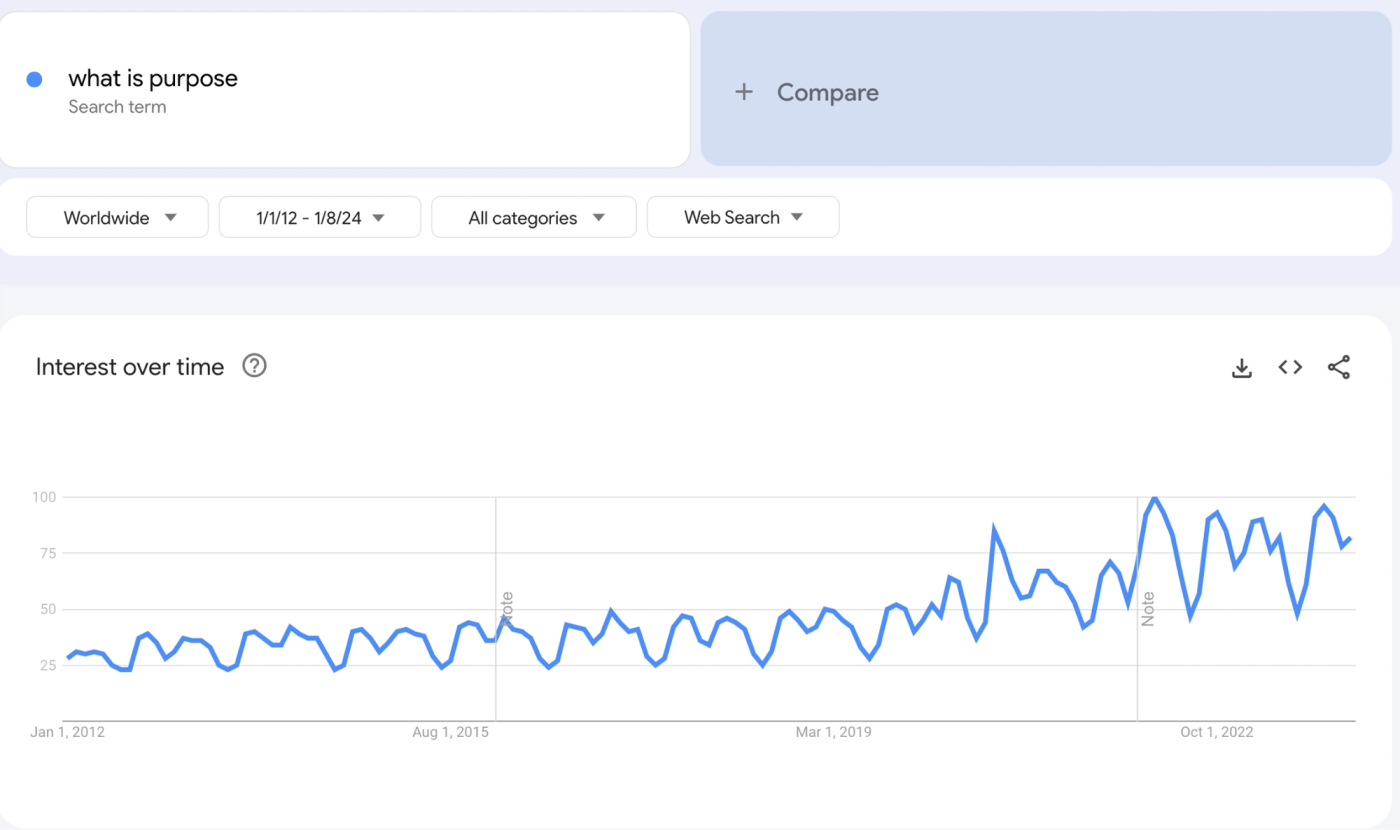
The idea of a purpose-driven business has been around for a long time. Simon Sinek’s TED Talk “How Great Leaders Inspire Action” from September 2009 has been one of the most widely quoted and influential contributions on popularizing the idea that a ‘Why’ is crucial in creating inspiring businesses and companies that customers can connect with.
So how do we define purpose in a business setting?
Some management consultants will define purpose as a compass. A central idea that gives direction to everything the business does. It’s a good start but in our opinion not inspiring enough to actually take action. Others will define a purpose as a north star. A light far in the distance that the business walks toward. Something that you will never really reach but can continue to aspire to. A different approach á la Simon Sinek would be to find your why.
At .beyondcomms, we have worked across a few different industries with different founders and realized that each approach has its own merit if applied in the right context. We found inspiration in the psychological definition for an overarching definition that offers different entry points. Therefore, the definition of business purpose that we propose is a combination of three aspects: 1) a star that guides its followers in a collective direction; 2) a well, that serves as a source of inspiration and nourishment for those who come to it; 3) a thread that guides action.

Our crude and simple visual representation of this concept
In short, a purpose is the radiating core of the business that inspires others to act toward an aim that is larger than the company itself.
How do you build a purpose statement?
While we won’t get into the whole process of defining your business purpose here, we will give you the anatomy of our clients’ purpose statements as a formula of sorts that you can apply to your own business.
Why are you in this world? = Action + Impact (+ Vessel)
We’re using Sinek’s central framing of the ‘why’ as a starting point for this. The why is then combined of an action that you aim to undertake with your purpose. Usually this will take the form of active verbs, followed by the type of impact you want to have. The latter can either be a general group of people (your intended target market) or an overarching topic or theme (e.g. sustainability) that your purpose focuses on.
Let’s solve this based on the example of .beyondcomms’ purpose:
Create and inspire impact-driven businesses through the power of purpose = Create and inspire (action) + impact-driven businesses (impact) + the power of purpose (vessel)
Here are a few tips to keep in mind when creating your purpose statement:
Make your statement grand and aspirational
Keep it short and succinct
If you were to tell the statement to someone, would they be able to associate your company with it?
Read your statement out loud - does it resonate?
The last element you shouldn’t underestimate is your emotional reaction to your statement. If there is no hairs standing up or at least some kind of tingly feeling when you read it out loud, then you probably haven’t hit your why just yet. In case, feelings aren’t your ‘thing’, test out your business purpose on your team or friends. How do they react? If their eyes widen with wonder and you receive a wave of agreement, then you might have just found your business purpose. A word of caution though! When it comes to your business purpose, don’t rely on the reaction of your friends or your target market to validate it. Your purpose has to work from the inside out, not the other way around.
From the .beyondcomms writing archive. References to offers, events and the practice reflect the time of writing.
Welcome, reader, to the first edition of A Shot of Purpose! We are excited to bring a little injection of purpose into your inbox each week. We'll explore how purpose can move businesses to connection, clarity, and action, featuring stories of purpose-driven leaders, practical tips on uncovering your business purpose, and insights on creating purpose-driven communication strategies and marketing campaigns.
Why are we doing this? Because we believe that impact-driven leaders who act on their business purpose can create a thriving world for their audiences. Thank you for joining us on this journey!
Let's dive into today's story:
In 2020, the team at telecommunications giant eir Ireland faced a corporate cognitive dissonance between high internal employee pride and declining customer satisfaction and public reputation. They didn't hire consultants or launch a positive PR campaign. Instead, they decided to face their attention inward and embarked on a search to define eir's purpose from within the company.
While there were probably many brainstorming meetings, they didn't just craft a statement between the leading directors, they wanted to understand what mattered to their employees and customers. Through town halls, surveys, employee ambassadors and conversations with 150 staff members across Ireland, they uncovered eir's purpose: "Connecting for a Better Ireland."
The results?
A set of new values for the company and a change in the performance evaluation of employees.
More than 90% of employees understand eir's purpose and their role in the strategy
The group unlocked additional investment at a shareholder level to support the next phase of work
Most importantly purpose has become a powerful strategic lever for change, reshaping everything from performance evaluations to partnership decisions.
What does it take to define your business purpose? Below are four steps that we take on the path to purpose:
Step 1: Internal Exploration and Understanding Step 2: Look at the External Environment Step 3: Your Customers Step 4: Organize your Information
Let's focus on Step 1 today and take 5 minutes to answer the below questions:
Why did you start your company?
Why is that important?
How did you get into your industry?
What does your company do?
Where are you currently struggling the most?
Take five deep breaths. Write down your answers. That's it. Leave those answers on the page and we'll see you next week!
From the .beyondcomms writing archive. References to offers, events and the practice reflect the time of writing.
Hi reader, welcome back! Last week, we took the first step on our purpose journey by looking inward. Those foundational questions you answered? They're about to become even more powerful as we explore how your external environment can validate, challenge, and ultimately strengthen your purpose.
Every business exists within an ecosystem of expectations, assumptions, and unspoken rules. While your purpose comes from within, its expression and impact are shaped by the world around it. Think of it like this: your purpose is a collection of strings on a violin, and the external environment helps you tune your chord to the right key.
This is exactly what we did with our client, Vancis Capital. They knew their purpose centered on empowerment and freedom, but they struggled to translate this to attract high-net-worth clients. Our external analysis uncovered some fascinating insights: while competitors focused on exclusivity, commoditization, and last-minute discount deals, there was a growing desire among wealthy individuals for transparency, honesty, and trust.
Here's what the contextual analysis unearthed:
Key messages across the industry emphasized expertise, convenience, and cheap deals, but rarely addressed operational and emotional aspects of a client journey
Most communication channels were either formal and distant or sensationalist and inaccurate, neglecting to provide information in a human approach
Visual identities looked the same across most companies, highlighting countries as holiday destinations and parading passports as if they were commodities
Press coverage revealed a gap between what firms were saying and what they actually delivered
Public sentiment showed growing distrust toward the industry, with many clients affected by scams
Our analysis didn't change Vancis Capital's core purpose, but it gave us some important pointers on how to express it in a way that would resonate more deeply with their audience.
Want to do a quick dive into your context? Take 15 minutes to explore the questions below.
What does your industry care about? Where do you see other companies place their emphasis?
What do you agree with in your industry? What are others doing well?
What do you disagree with? What rubs you the wrong way?
Who are the important voices in your space? What's their stance toward the work you do?
Most importantly: What are you doing differently?
Don't hold back on your answers, and make note of your approach and responses. Highlight some points of tension and harmony.
Let us know what you think of this week's piece and if there is any topic or question you want to have more info on. We'll see you next week.
From the .beyondcomms writing archive. References to offers, events and the practice reflect the time of writing.
Hi reader, welcome back and a Happy New Year! This week's edition features my conversation with Laura Avonius, Founder & CEO of Audicin. As part of our ongoing informal research into the impact and significance of purpose, I speak to founders and communication professionals. This is the second interview in the series. In the first one, I spoke to Michelle Toner to uncover the impact of articulating eir's purpose.
After many years in a successful corporate career, Laura found herself in a crisis of meaning. Health and personal circumstances compounded to create a profound period that had her question why she was doing what she was doing. Eventually, she found music and composition which allowed her to turn her pain into love.
The 'aha' moment that led her to begin Audicin came when she heard a brain researcher speak about the power of music to activate our parasympathetic nervous system. Something clicked, and Audicin was born to help those who are leading busy lives.
Audicin is a 'brainwave activating music app' that regulates the parasympathetic nervous system of listeners so that they can enter into a state of recovery while actively working. The app and approach are backed by scientific studies and research into music that regulates the nervous system. Binaural beats play a big role in how Laura and other artists approach the composition of their pieces.
The app promises that with just 15 minutes a day, users can reduce stress and anxiety, boost confidence, focus, and their overall wellbeing.
Audicin is a start-up led by a strong and passionate founder. The idea for the business started in a deeply personal place for Laura. Music had helped her weather traumatic experiences and in her words "turn pain into love." It is that feeling that she wanted to share with users of the app.
The purpose of Audicin is simple: Help people who are too busy doing active self-care with a straightforward solution to manage stress and anxiety, and improve their focus and sleep. Their ultimate vision is to make "access to self-care a fundamental aspect of daily life."
The path to the company's purpose begins at Laura's deeply personal point of departure. She was burnt out from a busy corporate career that turned meaningless and started to break through years of abuse with help from professionals. Music turned into a medium of healing and transformation. Audicin's purpose was born when Laura learned of the biological significance and impact that music can have on the nervous system.
There was a moment in Audicin's early stages when the company looked to secure lucrative, big corporate deals. Key messages focused on increasing productivity and focus for employees. The intention behind the sale ultimately turned out to help companies extract more value from their staff. This was far removed from Laura's purpose for the company of supporting passive recovery.
To no surprise, some deals came together, but Audicin wasn't growing as intended. The team couldn't get behind the sale and reconcile the dissonance. Only once Laura and the team abandoned the B2B angle did the growth and progress of the start-up take off. The marketing and communication materials aligned with the company's purpose and the team could confidently stand behind their sales. Recently, the team identified a new target audience that has already led to big research partnerships, funding commitments, and new insights for product development.
The Audicin team is fully remote and growing quickly after securing investment. We asked Laura how she ensures the company's purpose remains in focus during this moment of transition. Her answer lies in the hiring process. One of the first questions in the interview is "Why did you apply?" Seemingly simple, and yet it reveals the applicant's driving motivation.
As much as start-ups want to compensate their employees highly, cash-flow constraints and time to secure investment result in lower salaries than corporate counterparts. Therefore, team members must have an innate drive and alignment with the start-up's purpose to make the relationship successful. If the answer is: "I applied to enhance my portfolio" or similar, the team knows it won't be the best fit. No matter how talented the applicant might be, they ultimately, won't perform well in Audicin's culture.
From an operational perspective, Laura and her co-founder, Dr. Victoria Williamson, hold a weekly team meeting that regularly touches on the company's purpose. The meeting is designed to be democratic in nature, encouraging all employees to participate in strategic decisions such as which niche to focus on.
Audicin will continue to grow, and Laura knows that with additional investment and a growing user base, the company will have to withstand several challenges. Data will play an important role for her and her team to ensure that each activity is purpose-aligned and contributes to growth. Our interview ended with a reminder from Laura to be humble in the pursuit of your purpose. Nothing is perfect and some things will go wrong. If you remain humble and open to learning in an effort to fulfill your company's purpose, you are on a good path.
Let us know what you think of this week's piece. If you know of a founder or owner running a purpose-driven business, send us their names so we can invite them to the next interview!
From the .beyondcomms writing archive. References to offers, events and the practice reflect the time of writing.
Hi reader, when was the last time you listened to your surroundings? What does the world sound like when you open your window in the morning?
If you want to run your business from a place of purpose, listening is an essential starting point.
Listening means opening your mind and ears to the sounds and environment around you without judgment or getting caught up in how you respond. You might know this from conversational guides or networking tips - in that context, specialists recommend listening to your conversational partner's story instead of thinking of what to say next to keep the conversation going.
Listening in its purest sense is the same. When you listen, you are simply looking to receive information - no judgment, no analysis.
If you want to define your purpose, you need to start with listening. This can be both literal and metaphorical. There are two areas that you should listen to: 1) Internal, and 2) External
1) Internal
What are your biggest achievements so far?
What are the biggest lessons you've learned?
How did you get to your achievements and lessons learned?
How are you feeling about your current business activities?
When (in your business) do you feel excited? When do you not?
What is working well? What needs to be improved?
2) External
How does your team perceive your business? What motivates them?
Why do customers come to you? What keeps them engaged?
When is it easy for you to make money?
When it's difficult to get revenue and profit, why is that?
How do others talk about your business?
These questions are a small selection of the areas you can explore when defining your purpose.
It can be extremely difficult to listen without immediately responding. Naturally, you will hear something that might strike you as negative, and you'll want to jump up and react. That might be appropriate in a business crisis but not when exploring your purpose.
Listening takes practice. There are several ways you can improve your listening skills.
Listen to music (yes, quite obvious and yet we don't do it often) - don't do anything else and listen to a piece of music for 3-5 minutes. No driving, walking, or doing the laundry. Try to hear as many instruments, nuances, and sounds as possible.
Walk without your headphones - take a walk in nature or the city without headphones and take in the sounds around you
Listening requires you to be present. That's a difficult skill to master but there are some ways in which we can trick our brains when it comes to defining your business purpose:
Writing - Doing a guided, free-flowing writing exercise is a great way to articulate your inputs without judgment.
Association Games - modeled on theater improvisation exercises, you can play a game with your team: pick a topic and shout out words that come to mind.
In our work, listening is the first step we take with clients. In the marketing context, many would call this an audit. While there are many elements of this type of listening that result in an audit, there is one crucial area that many audits often don't take into account - Emotion.
If you want to turn your purpose into profit, how you, your team, and your customers feel are crucial insights you need to uncover. Even though we might pretend to be cool, detached, analytical business owners, we are emotional humans. If you don't feel excited about your purpose, you're not going to be consistent in acting on it. If your team doesn't feel inspired, it will be much easier for them to drop the ball. If your customers don't connect with your purpose, they most likely won't come back.
Listening will inevitably uncover emotions that can be important signposts to your business purposes. Only after we listened, do we get to define your purpose. But that's a topic for next week.
Let us know what you think of this week's piece. What steps are you going to take to listen?
From the .beyondcomms writing archive. References to offers, events and the practice reflect the time of writing.
Hi reader, last week I asked founders on LinkedIn about their priorities for 2025. The response was clear: business strategy clarity topped the list. If you're nodding along, you're not alone – and more importantly, it's never too late to gain that clarity.
This week, I want to share the of Wild Hideaways, an eco-spa resort that turned strategic clarity into remarkable results, achieving 99% ideal client bookings and exceeding their summer 2024 booking goals by over 10%.
Wild Hideaways began their journey in Fall 2023, when Amy and John were preparing to officially open their doors. Nestled in the wild countryside of Meleagh Valley, their four eco-lodges with a sauna and wellness offering aren't something you'd stumble upon during a casual drive. They knew digital presence would be key, especially with plans to launch a website for direct bookings and higher profit margins.
Building a cohesive brand across booking sites, social channels, and their website while staying true to their core intention: being an eco-spa resort that combines luxury hospitality with sustainable practices. We embarked on a six-week journey to create clarity in their brand strategy.
It started with deep listening. Here is how this time was structured:
Interview with Amy
Market Research of Regional Competitors
Previous Guest Interview
Writing Meditation
Refer to last week's Shot to see how you can implement listening practices into your business.
For Wild Hideaways, this listening phase revealed something crucial: their ideal guests were “Urban Nature Seekers” - people who respected the countryside, embraced nature and quiet, and needed an escape from their busy lives.
Armed with these insights, we defined Wild Hideaways' purpose and market positioning. Our research revealed two unique opportunities: the scarcity of dog-friendly accommodation in the area and their genuine commitment to sustainability – both setting them apart from competitors.
Together, we crystallized the purpose:
"Provide an escape to reconnect, recharge, and rest in the gorgeous nature of Meleah Valley where we respect and celebrate our surroundings."
With this north star in mind, we created Wild Hideaway's guest personas. If you are looking to define your business purpose, you can use our step-by-step guide.
With this clarity of purpose and understanding of their ideal guests, we developed the language that would capture their audience's imagination. We created key messages for different guest segments and defined the brand's personality – one that Amy or future employees could authentically embody. This work naturally evolved into a content strategy that felt true to their vision.
While they already had a strong brand identity, we created a mood board to guide their social media, photography, and videography, ensuring every visual touchpoint told their story consistently.
The final phase of the integration was left to Amy and John. We provided a detailed checklist of which channel to update to create a consistent brand expression. An idea that came up as we looked through everything turned into one of the bestsellers on the website: Three themed packages that would encourage booking add-ons with one click rather than during the stay.
I connected with Amy a few months after the completion of the project and she reported stellar results:
99% of bookings from ideal clients through her website
10%+ over the target for summer season bookings
Confidence in how to talk about her business and what elements to highlight online
None of this would have been possible without Amy's vulnerability and commitment to the process. Her willingness to dive deep into her purpose made our work not just effective, but meaningful.
Let me know what you think of this week's piece. What insight are you taking away to create clarity in your business for 2025?
From the .beyondcomms writing archive. References to offers, events and the practice reflect the time of writing.
Hi reader, two weeks ago, we explored how deep listening creates the foundation for purpose work. Today, we'll dive into the next crucial step: Defining your business purpose.
"Those who have a why to live can bear almost any how" - Friedrich Nietzsche
From Listening to Definition
The insights you gathered through listening – to your team, customers, and inner voice – now become the building blocks of your purpose statement. But what makes a powerful purpose?
At its core, purpose is the radiating center of your business that:
Guides strategic decisions toward a north star
Nourishes your inspiration like a well
Directs all actions along a central thread
Finding Your Core
Before we dive into crafting your purpose statement, let's explore where purpose lives. You might be familiar with Andrés Zuzunaga's Venn Diagram of Purpose where four circles intersect: what you love, what you're good at, what the world needs, and what you get paid for. At the center of these overlapping elements lies your purpose – the sweet spot where passion meets profession, and mission meets vocation. Hubert Joly aptly adapted Zuzunaga's concept to the context of companies. He determined that your company's purpose lies at the intersection of people's passion, economic value, the world's needs, and your company's strengths.
This visualization helps us understand why purpose is so powerful. To begin defining your purpose, elaborate on each of the outer circles. By defining your purpose, we are reversing the listening phase (from the inside out) and are working our way from the outside in.
Your Purpose Formula
After years of working with impact-led founders and hours of research, we've developed a simple formula to guide any purpose statement:
Why are you in this world? = Action + Impact (+ Vessel)
Take eir's journey as an example. Through extensive listening and reflection, they defined their purpose as "Connecting for a Better Ireland." This clear purpose led to 90% of employees understanding their role in the company's strategy and unlocked additional shareholder investment. The purpose statement is made up of the action, i.e. connecting, and the intended impact, i.e. for a better Ireland. In eir's case, the vessel is implied and remains malleable depending on the arm of the business.
Your Turn
In next week's shot, we'll explore how to integrate your newly defined purpose into your business operations. Until then, try this:
Write down your purpose using the formula above. While data and analysis are great, don't forget to take your feelings and gut into account. When you read your purpose, does it give you a tingle? If not, keep refining. When you're done, send me your purpose statement.
From the .beyondcomms writing archive. References to offers, events and the practice reflect the time of writing.
Hi reader, over the weekend, I finished a book that begins to upend the foundation .beyondcomms is built on. The title? The Road to Hell: How Purposeful Business Leads to Bad Marketing and a Worse World And how Human Creativity is the Way Out. The author? Nick Asbury.
Below is a shortened version of Goodreads' description of Asbury's book:
Asbury's book challenges the core assumption of purpose-driven business that emerged after the 2008 financial crisis. His central argument? The 'do well by doing good' mantra has backfired, leading to:
Inauthentic advertising that lacks impact
Companies overstepping boundaries on social issues
Businesses neglecting their core responsibilities
Through case studies of major brands like Bud Light, Patagonia, and Unilever, Asbury dismantles the current purpose movement and offers an alternative path forward: embracing human creativity and genuine empathy instead of corporate virtue signaling.
In an era where purpose dominates business strategy, this book is a timely critique.
.beyondcomms is built on my conviction that purpose will make for better businesses that do good for the world. The question that has always stuck with me is: Can an inanimate legal structure of a business have a purpose? The answer I arrive at is: No, a business cannot, but the people inside it can. From the start, I knew that marketing based on purpose tends to be weak, but purpose as an internal strategic lever can have some impact.
The most important function of a for-profit business is to make a profit. Profit that can nourish and sustain employees and leadership and grow the business. Every individual searches for their purpose or has found it already. Often, that lies outside of the organization they are working for. That's true for large corporations. A small start-up, on the other hand, is often driven by a spark of purpose. A purpose that the founders share and try to bring their new joiners along on.
Often, that purpose is not a grandiose moral obligation, but it can be as simple as "we want to become THE definitive platform for agentic testing" (Coval). It's a far-away aim that will take some time to achieve but allows everyone to rally behind. Laura acknowledged how important purpose has been in her story of founding Audicin and the role it plays in hiring people who align with the values of the company.
Asbury's argument calls for a more nuanced understanding of purpose in the context of business. For .beyondcomms, this means a shift in our foundation. We still unearth and center purpose.
We don't look at a grandiose business purpose. In the future, we will create spaces for founders and owners to unearth their purpose so that they can understand what kind of business they want to build. For start-ups and SMEs this understanding can be fundamental in understanding where business clashes with individual purpose.
When it comes to the business side, we focus on creating 'strategic clarity.' It doesn't have the same ring as the p-word, but it's much more accurate. Most of the founders I speak with have incredible ideas, interesting products, or amazing services. However, they often don't know how to align their communication with their ideal audience, falling into a pattern of marketing shoulds and hacks. What they need is clarity on where they are going in the short- and long-term and then they align their comms.
This week's piece was a little bit different from the usual content. It's the beginning of synthesizing an argument that has been ongoing in the marketing and advertising world. I will share further reflections on how this translates into your business and projects in the coming issues. In the meantime, let me know what you thought of this weeks piece by replying to this email.
From the .beyondcomms writing archive. References to offers, events and the practice reflect the time of writing.
Hi reader, this week we're looking at something every founder struggles with: the weight of all that you 'should' be doing in your business.
As founders and business owners, we are inundated with 'shoulds'. From Social media 'gurus' telling us that TikTok is 'THE new platform to be on" or the Hormozi's of the world telling us how we should be doing lead generation to reach six-figure months.
You should be hosting LinkedIn Lives
You should be on Social Media
You should put your face out there
You should be doing video content
It's a grueling place for anyone running a business, whether it's a founder-led brand or an SME with a bigger team. The constant suggestion that there is something else you 'should' be doing is overwhelming. Especially if your feeds are overrun with pseudo-influencers claiming to have the 'secret formula' for all your problems.
'Shoulds' are an "easy" manipulative marketing tactic. They position the writer as an authority. They push down on your pain, twist the knife, and then suggest their solution as the silver bullet that will solve all your problems. If you follow the call of a 'should' you will eventually look around and wonder where you are.
It might take a while to overcome the personal mental hurdles of all the things you 'should' be doing as a founder. (We'll leave that one for your therapist 😉)
For your business, there is a clear path to breaking free: strong foundations.
Your business mission and values
Your unique market position
Getting clear on your ideal audiences' actual needs
Your authentic way of creating value
If you have clarity on these points, 'shoulds' will begin to lose their power.
Imagine this: You know that your ideal audience makes most of their buying decisions after attending industry conferences. Suddenly the 'should be on TikTok' becomes irrelevant. Instead, you know to focus your energy and time on building meaningful relationship during events.
That's the power of knowing your foundation. Every decision becomes clearer. Every 'should' can be measured against your mission and your audience's genuine needs.
If you're feeling overwhelmed by all the 'shoulds,' let's have a conversation about finding clarity through purpose-driven communication. Book a free clarity call
I'd love to hear from you: what's the biggest 'should' pressuring you right now? Reply to this email, and let's see how we can transform this pressure into meaningful action.
From the .beyondcomms writing archive. References to offers, events and the practice reflect the time of writing.
Hi reader, the theme of today's 'shot' has come up often in my calls with founders over the past weeks. Many have started their ventures. As they look to grow their business, they want their companies to stand independently from their personal brands. This week, we'll dive into the difference between a business that's inseparable from its founder and one that becomes a living entity with a distinctive presence.
While a personal brand naturally flows from an individual's purpose and values, a company brand requires a different approach. Companies, as legal entities, don't inherently possess purpose. Instead, they need a clear mission and value propositions that can connect with the individual purposes of employees and audiences. One way to think about a company's brand is a collective experience of people inside and outside of the business.
Starting from the inside out: The brands that resonate the most amplify what already exists within the organization - its strengths, culture, and collective expertise. This creates a foundation that rings true because it's based on reality, not aspiration. Plus, it creates an environment in which teams can connect more easily with their work.
Harmonize with external needs: Once you understand your internal truth, find how it intersects with what your audience needs and values. Your positioning should create a resonance between internal capabilities and external demands. This ultimately is your unique value proposition that sets you apart from competitors.
Create systems and frameworks: Document your strategy through guidelines, templates, and processes that anyone can follow. These become the score that allows everyone to play the same composition consistently.
Establish daily rhythms: Brand building happens in the everyday moments. Implement regular practices across all functions - from how sales advisors present solutions to how operations communicate internally. Every action should reinforce your company's distinct voice.
Curious about putting this into practice for your company brand? Book a free clarity call to get ideas for where you can get some quick wins.
Remember that ultimately, your brand exists in the minds and hearts of your audience. While you can influence perceptions through consistent expression, the final interpretation belongs to them.
Like a musical composition, you can write the notes, set the tempo, and indicate the dynamics - but how each listener experiences the performance is uniquely their own. Your responsibility is to play with consistency and authenticity while accepting that the reception will vary.
Founders who successfully build enduring company brands understand this fundamental shift from personal expression to collective identity. They see themselves not as the permanent face of the company, but as the initial conductor who will eventually pass the baton.
Building a company brand that stands independently starts with these fundamentals - identifying what's already true, finding where it meets market needs, and creating systems to express it consistently.
From the .beyondcomms writing archive. References to offers, events and the practice reflect the time of writing.
Hi reader, in the brand strategy and communications world, 'purpose for companies' is going out of fashion. There is enough evidence supporting the idea that purpose-driven campaigns are ineffective and sometimes even harmful (see Nick Asbury's book). Nevertheless, purpose is an inherent human driver and important to our psychology. This week, we'll explore when purpose matters in the context of business.
Purpose is a key driver in how we live our lives. Some have a specific statement that drives their day-to-day activities, while others have a vague gut feeling that pulls them in different directions, and then there are several variations in between. No matter where you fall on the spectrum, psychologists have long established that purpose is key to living a long and fulfilled life.
When we don't live aligned with our purpose, we have a hard time getting up in the morning, or daily activities seem like a drag without much impact on our lives.
In an employee's lifecycle, we often see excitement and motivation when starting a new role. The first few months are a period of adjustment, learning, and understanding the new workplace. After a few months or years, there will be an inevitable drop in performance unless the role fulfills a purpose in the employee's life.
It's easier to justify working 80-hour weeks as a consultant if the pay is high and funds the lifestyle you want. Working for an underpaying NGO can be fulfilling if you see the positive impact your work has on individuals or communities in need. In either scenario, the individual fulfills all or a part of their purpose.
There will come a point when motivation fades. Though, I will leave it up to HR professionals to write about how the link can be reestablished. If you want to retain employees, what matters is that the work they do has a specific purpose in their lives - even if it is as simple as earning money to live.
Founders are an interesting variation of humans. They create a business from almost nothing and have to drudge through being everything for their business until they have enough resources to hire talent. Even then, the game changes to scaling and maintaining.
Many founders start their projects with a clear sense of purpose. That could be solving the climate crisis through land regeneration projects or building a product that will revolutionize the work of accountants.
Now, this is the point where most founders make a big mistake. They turn their purpose into that of the business.
When founders conflate their purpose with the business's, they often fall into dangerous traps:
Assuming their team will work for less compensation simply because they share the vision
Believing purpose alone can drive business strategy without the strategic roadmaps
Team members are left wondering about the practical path forward, without clear daily actions.
The antidote? Founders can use their personal purpose as an internal compass to measure their business decisions and strategy. A founder's purpose can be great for the individual to develop discipline and find a grounded strength during tough times. When translating purpose into the business context, you must acknowledge the realities of running a profit-driven enterprise.
A company, as a legal entity rather than a person, doesn't truly have a "purpose" in the human sense. Rather than prescribing an abstract company purpose, founders can clearly articulate why the company exists and what specific impact it aims to have – essentially, its mission.
Let's abandon the idea of a business's purpose. (Radical? I don't think so.) 'Purpose' has been appropriated by the marketing world and is now considered a buzzword. Contrary to what some strategists and marketers would like you to believe, purpose statements alone don't translate to direct business results.
Let's think less about grand moral purpose statements and more about a clear mission that everyone can rally behind. What will lead to results is having a coherent framework that connects why the business exists (mission), how it operates (values), and what it does daily (actions).
In business, purpose can come into play when you ask:
Are employees able to fulfill aspects of their purpose through their work? Is it financial security, personal fulfillment, social impact, or some combination? The answers should inform internal processes, structures, benefits, compensation models, and leave policies.
Understanding the purpose of the business's audience can create avenues for campaigns and marketing activations. It also creates further clarity on product and service offerings.
Overall, purpose matters for business when it creates harmony between individual goals and organizational direction – not when it's merely a statement on a website or in an annual report.
How are you using the idea of purpose in your business? Let me know by responding to this email.
From the .beyondcomms writing archive. References to offers, events and the practice reflect the time of writing.
Hi reader, today's markets are noisy and crowded; there's no doubt about it. Some businesses try to shout over the masses, while others whisper to their neighbors, building small circles of influence. Without proper resources, those who try to be louder than everyone else eventually lose their strength and voice. And the whisperers will eventually face a natural boundary for their ability to reach larger groups.
The sweet spot for sustainable growth is a middle ground in which many hear and see you while you build meaningful relationships with your key audiences. Carving out that space requires a harmony of your positioning and voice.
Your positioning is the unique space you occupy in your customers' minds. Fundamentally, the positioning statement is built on your unique value proposition, with a specific view of the market space you occupy. I tend to think of it as the space you occupy on the stage: If your positioning is weak, your space is small; if it's strong (like the energy of a diva), you can occupy more space.
Your business voice is the tone, language patterns, and personality that express your brand across all touchpoints. It's how you, your team members, and official business communication show up in emails, social media, presentations, and even casual conversations. If you cultivate a specific tone of voice that's easily recognizable (think of Sia), your audience will instantly recognize you.
Positioning and your voice must work together. A distinct voice without positioning is like listening to an actor deliver their lines without any emotion - sounds nice but stirs up nothing. Positioning without voice is a brilliant strategy delivered in a forgettable way - powerful in theory but ineffective in practice.
How do you know if your business voice is working? Here are a few warning signs:
Your tone fluctuates wildly across channels. If your LinkedIn posts sound nothing like your website, which sounds nothing like your emails, you're creating confusion rather than recognition.
There's a disconnect between your communications and your mission. When how you speak doesn't align with what you stand for, audiences sense the dissonance.
Writing content feels uncomfortable or forced. When finding words is a constant struggle, it often means you haven't settled into your authentic voice.
Start with what makes your business unique. Your UVP isn't about the features and benefits of your service or product. It's also not about your awards or accolades. To get to your UVP, ask yourself:
What problem do you solve in a way no one else does?
What makes you impossible to replicate?
What would your ideal clients miss if you disappeared tomorrow?
Your business mission provides the perfect foundation. When your voice reflects your deeper "why," communication becomes both easier and more effective.
Consider:
What drives us to do the work we do?
How do we live our mission every day?
How do we want people to feel after interacting with us?
Meaningful connections happen when your voice resonates with the right people. You don't have to appeal to everyone. All you have to do is connect deeply with those who share your values and vision.
Think about:
What language does your ideal audience use when discussing their challenges?
What tone would feel most natural in a one-on-one conversation with them?
What communication style builds trust with the specific people we serve?
Take 10 minutes with your notebook (or a blank document) and imagine your brand at a Cocktail Party:
You are entering a busy party with people mingling and talking?
What is your brand like when they enter? How are they dressed? Are they shy or confident? What conversations do they have?
After a few drinks in, they are feeling looser and less inhibited
What are they like then? How do they speak? What is their approach toward other guests?
Your authentic voice and strategic positioning will create spaces for meaningful communication where connections can thrive.
From the .beyondcomms writing archive. References to offers, events and the practice reflect the time of writing.
Hi reader, last year, I was on my final call with a client, ready to present the brand story we had crafted. After I finished reading the story to them - silence. It was dreadful! When I switched back to their window, I found them with tears in their eyes and a wide smile - relief. The story resonated. A well-crafted brand story is not just words on a page - it’s an embodiment of your mission, values, and vision distilled into a narrative that creates an emotional connection. Let’s explore how you can create brand stories that resonate.
Your brand's story has to be a truthful narrative that connects your audience to the core of your business. These five elements are important to consider:
Authenticity: Are you sharing genuine experiences and motivations?
Emotional connection: What are the universal human experiences we all share that you are tapping into?
Mission alignment: How are you connecting your “why” to the needs of your audience?
Values in action: How are you demonstrating your principles inside your business?
These elements informed how we wrote Wild Hideaways' story that moved our client to tears. It wasn’t just about luxury eco-lodges in West Cork. The brand was born out of the co-founders' deep connection to place, their journey home, and their desire to share the tranquility they found with others who need it.
You are probably familiar with the traditional story arc that most narratives are based on.
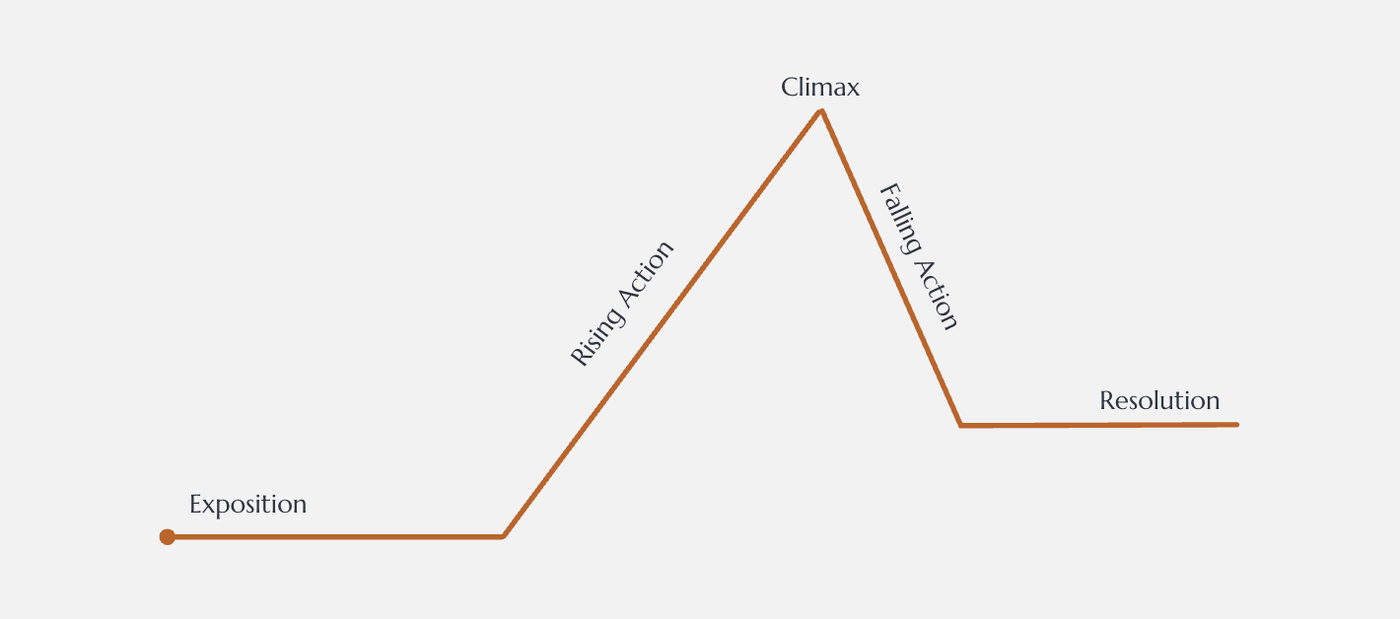
Traditional Story Arc
A resonant brand story will follow a similar model with a slight reframe.
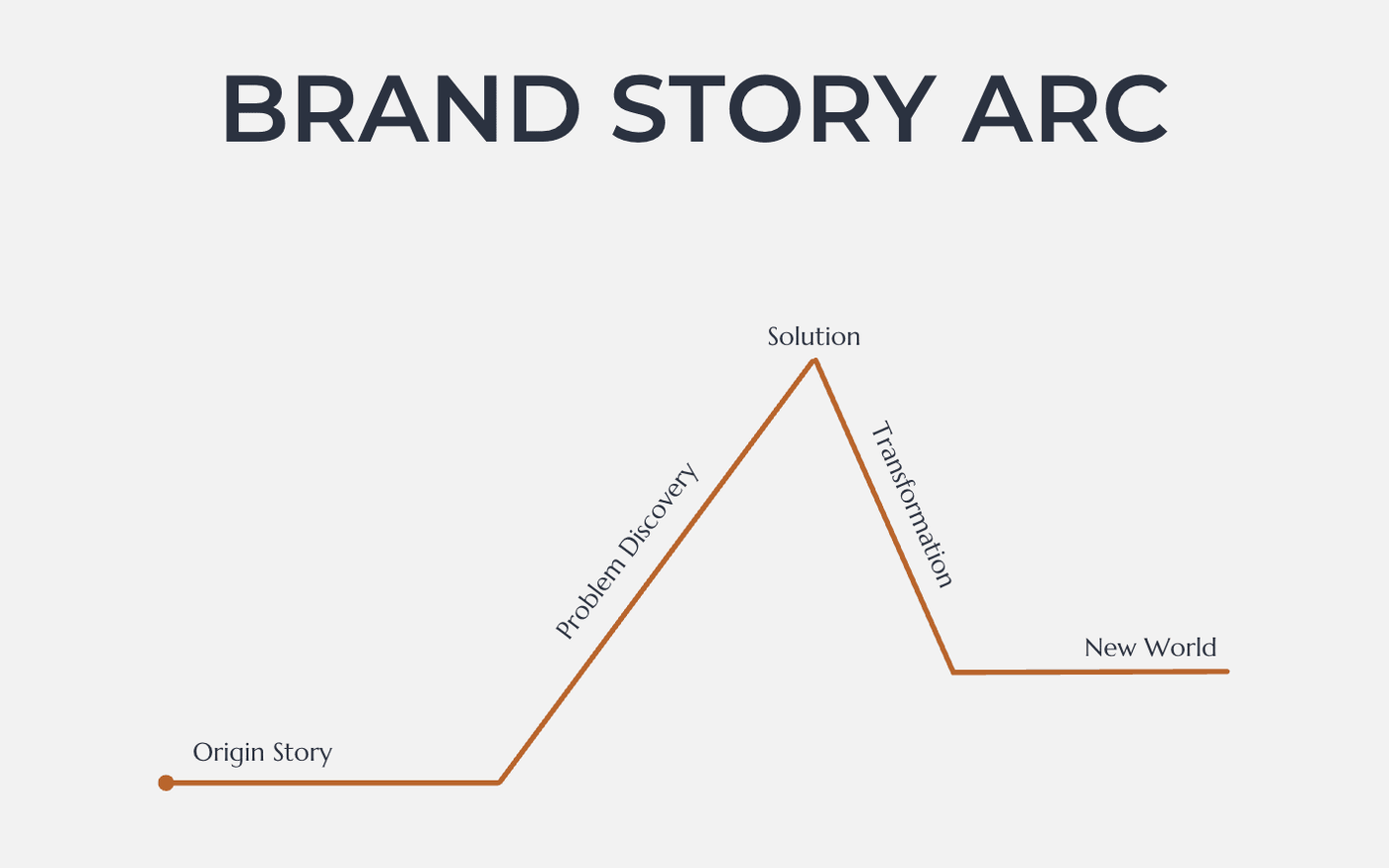
Representation of a Brand Story Arc
In this arc, we see five elements:
Origin Story: Here you write about how your business came to be. This can include personal stories or a short relatable anecdote
Problem Discovery: This part needs to establish a stronger personal connection with your reader. Demonstrate empathy and articulate the problem you are looking to solve clearly.
The Solution: This is the traditional climax. Here you present your solution. This part should make your solution obvious and unavoidable.
Transformation: This is your opportunity to build trust with your reader. Showcase existing transformations of clients or testimonials here, or describe the exact transformation you want your audience to experience. If you have any accolades, you might consider adding them here if they lend credibility.
New World: In this part, you can describe your brand universe the audience will have entered after their transformation. You must keep the focus on your audience. Don't fall into the trap of just talking about your brand.
Here is Wild Hideaways' story started as an example:
“The story of Wild Hideaways takes us back over 30 years to 1995. After they met in Manchester, UK, Amy visited John’s family home in the Mealagh Valley. For Amy, it was love at first sight. She describes an immediate feeling of home.”
"Embracing adventure led the couple to spend many years in Australia and they built their family and life there. When it became time to move closer to home in 2014, there was only one choice - The Mealagh Valley. John's experience in construction and management, together with Amy's knack for customer experience and interior design makes them a dream team. The O'Sullivans are deeply rooted in their environment and see their venture as an opportunity to highlight their community and the beauty of the place they call home."
"Wild Hideaways is Amy and John O'Sullivan's answer to the overwhelm and hustle of urban life. The Eco Spa Retreat offers an escape into the beautiful and wild landscape of the Mealagh Valley and beyond."
"The eco lodges have already reached local acclaim and admiration for their commitment to sustainable practices. Guests who stay on the property celebrate the mix of relaxation, adventure, and the striking views across the West Cork landscape."
"Wild Hideaways is John and Amy's love letter to this hidden gem in Ireland. They invite guests to step into their world and embrace tranquility and serenity."
The sequence of the elements can be different. For example, you'll see on Wild Hideaways website that the solution is stated at the start, with the rest following in the order it is here.
Before you share your brand story with the world, run through this checklist:
Evoke a genuine emotion
Communicate your mission clearly
Highlight your values in action
Invite your audience to participate in your journey
Create a sense of place or belonging for your audience
If you're not hitting all of these points, you might have to revisit your story. Float a draft by a valued audience member or even an outsider and see what they think. Remember, the goal isn’t to impress - it’s to connect.
A beautifully written brand story means little if it’s not reflected in the day-to-day experience of your audience. Wild Hideaways doesn’t just tell a story about tranquility and connection to nature, they deliver it through thoughtfully designed eco-lodges with stunning views, sustainable practices, and experiences that allow guests to truly disconnect.
Your brand story must be embodied through:
Customer interactions: How your team communicates and serves
Product/service delivery: How your offerings fulfill your promises
Physical and digital environments: How your spaces feel and function
Communications: How consistent your messaging is across channels
Partnerships: Who you choose to work with and how
Internal Processes: How well you integrate your team and stakeholders in the story
When your story is lived, not just told, it creates a powerful coherence that builds trust and deepens connection.
The most resonant brand stories aren’t confined to “About Us” sections. They’re expressed through every aspect of your business. As mission-driven founders, our challenge is to ensure this consistency. When we do, our businesses become more than providers of products or services - they become meaningful parts of our audiences’ lives.
List all the avenues your audience interacts with your business (website, social media, email, physical location, customer service, product/service delivery, onboarding process, etc.).
For each touchpoint, answer:
What elements of our brand story are expressed here?
What values are demonstrated?
Is this consistent with our written story?
What might our audience feel when experiencing this touchpoint?
Answer the following
Where is our story not coming through clearly?
Which touchpoints feel disconnected from our core narrative?
What 2-3 areas would have the biggest impact if improved?
Select 3 top priority touchpoints that will bring you the quickest wins and outline specific actions to better embody your story through them.
This simple audit will help ensure your brand story isn’t just told but lived through every day of your business.
From the .beyondcomms writing archive. References to offers, events and the practice reflect the time of writing.
Hi reader, when did you last feel creative? What does that mean to you? Creativity is an elusive little word. For some, it sits firmly in the space of artists, creators, and designers, for others, it means problem-solving. I've been rereading Twyla Tharp's book 'The Creative Habit,' and this week seems as good as to focus on insights on how we can catalyze creativity to fuel mission-driven businesses.
I'm a sucker for definitions, so let's start with the Cambridge Dictionary one: Creativity is "the ability to produce original and unusual ideas, or to make something new or imaginative." The creative act often starts with nothing - a blank page, an empty room, a blinking cursor on our newsletter. Then we draw from our experiences, reference materials, research, competitors, and a variety of sources to come up with an imaginative idea.
In her book 'The Creative Habit,' choreographer Twyla Tharp dispels the myth that creativity is some magical gift few of us receive from time to time. Instead, she makes it much more accessible: creativity is cultivated through consistent practice and ritual.
In a similar fashion, entrepreneur, Jason Roberts framed a similar practice as Increasing Your Luck Surface Area: "The amount of serendipity that will occur in your life, your Luck Surface Area, is directly proportional to the degree to which you do something you're passionate about combined with the total number of people to whom this is effectively communicated." Substitute 'serendipity' with creativity and think about communicating with yourself, and we have the idea of increasing your creativity surface area.
Looking at creativity in this manner is quite liberating. Suddenly, it transforms from an ephemeral term shrouded in mystery to a muscle we can strengthen deliberately. In today's noisy market space creativity becomes a competitive advantage. So let's look at how we can cultivate it.
Many artists use rituals to wake up their bodies and brains to the creative process. It's often a form of grounding and can be as simple as the same vocal warm-up for a singer to Tharp's morning ritual of getting into a taxi at 5:30 am to go to the gym and prepare her body for the day. Our brains love rituals - predictive patterns that don't take a lot of our energy but ground us in action. There are countless examples of high-performing entrepreneurs who credit daily rituals as a key factor for their success:
Sara Blakely - Morning visualization and alternate driving routes
Jack Dorsey - Theme-based days and dawn meditation ritual
Arianna Huffington - Tech-free evening bath and physical book reading
Jeff Bezos - No early meetings and scheduled "wandering time"
Oprah Winfrey - Meditation, movement, and five daily gratitudes
What could be the creative ritual for your company? The simpler the better.
Jocelyn "The Brain Lady" Brady uses SHITstorming to unlock playful ideas and inspire creativity. That could be the start of your meetings to get creative. Another could be getting your team to move around - maybe play musical chairs?
Think about a simple exercise that can signal to your team and your brain that it's time to create. Something that creates space and gives everyone permission.
Often you'll hear people say: "No idea is really new. Everything has been done before." There is great power in that statement. If everything has been done before, the uniqueness comes from putting things together in new imaginative ways to create ideas.
One of Tharp's important action to create is a practice she calls 'The Empty Box.' At the start of every project, she starts a new box. This vessel will hold everything she comes across related to the project - research, clippings, films, images, quotes, interviews ... you name it. As the project develops the store of knowledge grows and can provide important insights when she's stuck and needs a boost.
What is the empty box for your business? How are you capturing ideas?
You could create a Slack channel named 'The Stupidest Ideas' and have your team drop whatever comes to their mind in there. Collect random quotes, GIFs, and coffee musings. When it comes to solving a strategic problem, you find a gem.
If you think that a yearly retreat into the mountains with your team will solve your strategic problems, you are sorely mistaken. Creativity isn't something you spend a weekend on, pat each others' shoulders, and go back to your day-to-day. If you don't embed creative practices in your organization you'll quickly fall behind the competition.
So how can you turn creativity into a continuous practice? Here are some ideas:
Structured Creative Time - Google allows employees to spend 20% of their time on their creative/personal endeavors. What are ways in which you can bring creative time into your business? Maybe that's a 5-minute play exercise at the start of big meetings, or perhaps it's dedicated slots in the calendar on a weekly or monthly basis to focus on creative ideas.
Systems for Cross-Pollination - Create formal processes through which teams across different departments can share ideas and insights. The bigger the mix of background and experiences, the higher the likelihood a brilliant idea emerges.
Infrastructure to Capture Ideas - How are you capturing ideas that are floating around in your organization? You can use a Slack Channel or WhatsApp group. Maybe a Notion board works better - Make it really simple for your team and yourself to drop ideas that come to mind before they disappear again.
If you're based in Dublin and craving some space for creativity and working ON your business, I just launched a workshop that will transform reactive business into purposeful direction. Join me on April 29th at 12pm.
Tharp describes this great exercise 'Egg' to start a creative session. When you are alone in a location with some space around you try this:
Sit on the floor
Bring your knees to your chest, curl your head down to your knees, and make yourself as small as possible
When you can't be any small, start to expand
Listen to your body and stretch out parts that want to expand (e.g. your head, your left toe, your right index finger)
Explore different shapes you can make with your body
Have fun!
This exercise doesn't only get you into your body but it'll activate your sense of play.
From the .beyondcomms writing archive. References to offers, events and the practice reflect the time of writing.
Hi reader, I sang in an opera last week in Ireland's largest national theatre. As I was looking onto the stage from the wings, I kept reflecting on the great power that lies in operatic training. Often with no amplification, the singers' voices carry over a large orchestra into a crowded hall. How do these soloists make themselves heard? And what can we learn about our business from them?
The key for a singer is to find resonance. The same principle applies in your business communication - where can you find the resonance that carries your voice over all the noise? How can you become a soloist and avoid straining your voice, shouting from the top of your lungs, or fatiguing the audience?
Let's dive in
Soloists understand that amplification comes through resonance, not volume. Imagine a speaker, if you crank up the volume incredibly high, the sound will eventually become distorted. But if you hold a conical shape in front of it without adjusting the volume dial, the sound will travel further and appear louder without distortion (if you want, that's a fund experiment to try at home).
There are resonant places in our face (in singing referred to as the mask) that we can place our voice into to amplify the sound. Several cavities allow us to create different resonance. Musical singers will often sound a little bit nasal because they place their voices right in front of the face, using the cheeks and sinuses, while opera singers often sound a little bit bigger and fuller because they place their further back in their throat and throughout their face.
To apply this in your business, think about it this way:
If you think about your business as an organism and a body that encompasses your various stakeholders, think about where placing your voice will resonate the most.
Understand the natural strength of your business, i.e. are you naturally stronger in content creation or direct outreach? Is customer service a strength of process quality?
Identify in which spaces your voice resonates the most, i.e. is it easier for you to be heard at trade conferences or on social media channels? Do videos work better for you than written articles?
Find resonant voices in your organization, i.e. are there specific teams or individuals who share a natural affinity to the business and can they amplify your voice through theirs?
A continuously misplaced voice in singing will create strain and eventually damage vocal cords. The same is true in your business, misplacing your resources and amplification will create burn-out and might even harm your reputation.
The most recognizable voices have distinct qualities. Think about it Louis Armstrong had a gravelly and raspy color, Maria Callas is known for her dramatic differences between high and middle registers, and Andrea Bocelli is celebrated for his warm, honey timbre with liquid quality. Each singer will have developed techniques to lean into the unique timbre of their voice.
In your business, we call it your unique value proposition expressed by your brand personality:
A strong and unique value proposition will make you stand out among your competitors
Your personality will create resonance with the right stakeholders, bringing them on your side, charming them into action
Leaning into your specific color will draw more people to you and create an unfair competitive advantage in the market.
When you develop a distinct timbre, you don't have to be the loudest, all you need is to be present, and the right audience will recognize you instantly.
The most listened-to vocalists don't sing loud all the time. They understand the power of dynamics and the impact of singing soft, loud, quiet, and everything in between. Did you know that it's more difficult to sing quietly than loudly? Singing in pianissimo (super quiet) takes a more sustained airflow to keet the voice carrying across a space with resonance.
You can apply similar principles in your business communications:
Some moments have to be louder to be heard (launches, big announcements, partnerships)
Others might benefit from intimacy and quieter tones (customer appreciation, community building) - note how maintaining these can be difficult and take more resources. Plan accordingly
Contrasting your dynamics will create rhythm and interest in your communications
Apply the principles above to your business communications this month:
Find your resonant spaces: Which channels naturally amplify your message? Where do you receive the strongest engagement with the least effort? What stakeholders are your natural amplifiers?
Solidify your warm-up routine: Determine daily practices that will strengthen your business voice. It could be consistent content creation, meaningful engagement, or regular reflection on your core message with your audience.
Create a performance schedule: Plan when you will project more, and when you will create intimate moments with your audience.
Rest and recover: Even the greatest vocalists need vocal rest. Build deliberate pauses in your communication schedule where you listen rather than speak.
If you're based in Dublin and craving some space for creativity and working ON your business, I just launched a workshop that will transform reactive business into purposeful direction. Join me on April 29th at 12pm.
Most vocalists will have a few signature pieces where their unique abilities feature the best. What is your business aria? What type of communication showcases your distinctive value most effectively?
For some, it might be thought leadership articles. For others, it's intimate community engagement. Some shine through visual storytelling or data visualization. Your aria must combine your natural strengths with the needs of your audience.
I'd love to hear about your experiences finding your business voice. What helps you amplify without shouting? Reply to this email and let me know.
From the .beyondcomms writing archive. References to offers, events and the practice reflect the time of writing.
Hi reader, I have been talking to several founders who are incredibly excited about building their products or services. They draw excitement from hunkering down writing code or looking at how to optimize their client delivery. That's all great, but I can see one clear warning sign: Most of them follow whatever is in front of them on the day, they adapt quickly based on feedback they receive, or they build their strategy based on the latest market insights.
In short, they lack long-term direction in their business. This week, we'll dive into how you can action some of the signs that your business might be lacking direction. Don't worry, these aren't meant to take weeks or months. You should be able to get to a point of strong conviction in the matter of hours.
When you find yourself saying yes to every opportunity that comes your way, you are reactive instead of taking action with intention.
A simple switch you can make: Create a mission-aligned filter with three questions:
Does this opportunity align with our mission?
Are we moving closer to our vision?
Is participating an expression of at least one of our values?
For any opportunity that doesn't receive three clear "yeses", you should spend time considering the cost/benefits. We've all taken opportunities because of financial realities or influence. Do make sure that they are not taking up space in your business that could be used to further your mission. Think about it this way: Every 'No' will define your business just as much as a yes, sometimes even more.
Inconsistent marketing reveals a lack of understanding of your stakeholders and signals insecurity. If you are unable to believe in your marketing efforts and key messages, why should anyone else believe in them? When your messaging changes drastically month to month, your audience will struggle to connect with your story.
A step you can take today: Create a messaging framework document that includes:
Your unique value proposition in one sentence
Three key messages that support this proposition
The words and expressions you'll use to describe your offering
Your brand's personality
Before you approve any new materials, run them through this framework. Does the content reinforce your core messages, or does it diverge into new territory? Consistency builds recognition and trust.
You and your team might be incredibly busy with hundreds of tasks every day. If that busy isn't underpinned by an understanding of the mission, your team is focusing only on tactics. In turn, you might have a short-term boost of metrics but you'll lack impact in the long-term.
To-Do at your next meeting: Dedicate 30 minutes to:
Articulate your big mission for everyone
Ask each team member how their work connects to this mission
Create space for questions about the "why" behind key initiatives
Ruthlessly cut any tasks that don't serve the mission
In these 30 minutes, you should be able to create the context that makes everyone's work meaningful, shifting focus from task completion to mission fulfillment. Do this at least once a month.
If you're based in Dublin and craving some space for creativity and working ON your business, I just launched a workshop that will transform reactive business into purposeful direction. Join me on April 29th at 12pm.
Without a shared understanding of your mission, decisions become exhausting negotiations rather than straightforward decisions.
A fundamental document: Develop a one-page decision-making framework that includes:
Your mission statement at the top
Your 3-5 core values
Key questions to evaluate alignment
A simple scoring system for major decisions
When anyone in your organization faces a strategic decision, they can refer to this framework first. Often, they will probably be able to make the decision themselves. At the very least, you'll be amazed how quickly alignment emerges when everyone uses the same filter.
If this kind of document could be helpful in your business, let me know by replying to this email and I'll send you a sample.
When we're unclear on our direction, we tend to mimic competitors. At the beginning that might be fine to find your footing. But if you want to build a truly memorable, long-lasting brand, you will have to embrace your voice.
A quick workshop: Schedule a 2-hour session to identify:
How your ideal audience communicate and what they respond to
What personality your brand has (look at some archetype examples for inspiration)
Decide on 3-5 ways in which you express this personality (e.g. is it through memes, high-production videos, quick witty tweets)
After the session, commit to implementing these insights and aligning all communication to this specific tone of voice and personality. If you stick with this for at least 60 days, you'll begin to see how your audience will connect more deeply with you.
Which one of these is getting you the most excited? Reply to this email and let me know which action you'll implement first. I'd love to hear about your experience.
From the .beyondcomms writing archive. References to offers, events and the practice reflect the time of writing.
Hi reader, Happy Easter Sunday! The air this morning was filled with the sweet smells of blossoming flowers and the greens around us are intensifying. Spring is coming, and the Easter season rings in a time of renewal and transformation.
Just as Easter represents the possibility of rebirth, our businesses, too, can experience moments of profound transformation when we deliberately create space for something new to emerge.
In nature, we need nutrient-rich soils for seeds to germinate and take root. They need a specific place where these delicate beginnings can grow. Many won't develop, but the strongest survive and will create beautiful plants. Similarly, we need to create spaces in business to sow ideas and see which ones take root. As we enter a new week, try the following:
Step away from daily operations at least twice a week to regain perspective and develop a clear mental space
Come together with your team at least once a month to discuss strategic ideas and initiatives, creating creative spaces
Check in with your gut and ask your team for their feelings about the business's direction in relation to your mission, opening emotional space
One of the most important elements of transformation and rebirth in business is creating empty spaces that can be filled with new ideas, initiatives, or direction. How often have you been afraid to let go of something because you didn't know what was coming next?
Maybe it was a campaign idea - you worked on it for months, and after two weeks, you realize it's not working. You don't know what can replace it, and you've already invested so much. Instead of cutting the campaign, you throw more money at it (maybe you didn't get enough eyeballs on it).
I've been there; letting go is hard. The Easter season is a great reminder that we need to create space for new ideas to emerge. Let go of the things that don't serve your business mission. You'll soon find that the empty space will be filled with new ideas, initiatives, partners, and clients who are more aligned.
What are you going to let go of next week? Reply to this email and let me know.
From the .beyondcomms writing archive. References to offers, events and the practice reflect the time of writing.
Hi reader, you hear this with entrepreneurs all the time - we want to stay agile and lean. From a management perspective, that's great. But this often seeps into how businesses approach their communications: react fast, adapt quickly, move with the market. In a time when everyone is inundated with notifications and rapid changes, here is something you can leverage for your business: the strategic pause.
This liminal space can transform your decision-making, strengthen your messaging, and ultimately drive better results.
In architecture, liminal spaces are thresholds - neither here nor there, but the transitional area between. In business communications, a liminal space is the pause between:
Receiving feedback and crafting a response
Drafting content and publishing it
Receiving an opportunity and committing to it
These spaces aren't empty – they're where the real transformation happens.
To be clear, this pause doesn't need to be a 3-day retreat into the mountains on the other side of the world to come to a revolutionary new insight. This liminal space can be a split second between action and reaction.
When you are not aware of leveraging this liminal space, you run the danger of:
Weakening your brand position: Without the strategic pause, your messaging will inevitably mimic your competitors, drifting toward market norms rather than reinforcing your unique position.
Opportunity costs rise: Reactive businesses often say "yes" too quickly to misaligned opportunities and "no" too hastily to the right ones.
Decision fatigue and overwhelm: your team will quickly become overwhelmed by too many reactive decisions, leading to poorer choices and lower retention rates
Receiving feedback and responding to it is a given in business. Next time you receive customer feedback on a service or product, instead of making changes immediately, respond with a kind acknowledgement and gratitude.
On the back-end, implement a mandatory reflection period (24 hours or even just 1) before making any decisions. This will allow you to consider the consequences for the business more broadly.
Soon you'll be able to identify patterns that can lead to uncovering root issues in your business rather than just symptoms.
During an incubation, you can nourish an idea before putting it out into the world. Instead of writing a piece of communication and immediately putting it out into the world, hold off for a few minutes or hours (depending on how much time you have), and consider three perspectives:
Your business perspective: Does it align with your mission?
Your ideal client's perspective: Does it address their needs?
A detractor's perspective: Where are the holes?
After the initial draft, step away, ask yourself these questions, and return to another version. If you are working with a team, you could have each team member inhabit a different perspective.
Diverse views will result in more resonant messaging that connects more deeply with your stakeholders.
This space might only be a second long if you have to make quick decisions. In this case, it's important to have a clear understanding of how your mission plays out in the world. Spend a few minutes going through the below exercise to make quick decisions more seamless.
Create a simple one-page document with:
Your mission statement
Your values
Your stakeholders
Your key messages
Your roadmap
Have it somewhere handy until you internalize this and refer to it every time you have to make a strategic decision.
If you're based in Dublin and craving some space for creativity and working ON your business, I just launched a workshop that will transform reactive business into purposeful direction. Join me on April 29th at 12pm.
The businesses that know when not to speak often develop the most compelling voice. 37signals is a great example of a company that takes strategic pauses. They don't have to slow down your business – they ensure every communication moves you purposefully forward rather creating motion for motion's sake
What communication in your business could benefit most from an intentional liminal space this week? I'd love to hear your thoughts.
From the .beyondcomms writing archive. References to offers, events and the practice reflect the time of writing.
Hi reader, when we talk about purpose-driven companies, the same names often dominate the conversation – Patagonia, TOMS, Cadbury. While these corporate giants deserve a little recognition, they often make purpose seem like a luxury only accessible to established businesses with abundant resources.
The truth? Purpose-driven business isn't about size or resources. It's about intention, alignment, and consistent action.
In my work with founders and SME owners across industries, I've observed that authentic, purpose-driven companies share these characteristics:
Their business model directly addresses meaningful challenges facing their customers, communities, or the planet. Often, the business is born out of a transformative experience or daily struggle. Take Victoria Finlay and The MenoPal - stemming from her experience with menopause and peri-menopause, she and her team are building a companion that guides and supports women through this crucial period in their lives.
Purpose isn't a marketing initiative but a practical filter for strategic choices, from partnerships to product development. Amy O'Sullivan with Wild Hideaways employs this practice for her luxury eco-resort and spa. Sustainability and giving back to the community sit at the core of the business, so she works with local vendors, partners, and employs local community members.
Beyond profit margins, they track metrics that reflect their impact on all stakeholders. Toast Brewing from the UK is a great example of this practice. With a mission to reduce food waste across the UK, this craft beer brewery uses bakery food waste to brew its ale. Beyond measuring their financials, they also track a number of other metrics related to the food waste they are able to upcycle.
Their messaging resonates because it springs from genuine conviction rather than market trends. Just look at the buzz and excitement around TechFoundHer Summit in Dublin 2025. Máirín Murray and her team communicate with genuine excitement and urgency around uplifting female tech founders and addressing important gender disparities in the tech industry.
Purpose influences everything from supply chain to customer service, not just external communications. Bruno Olierhoek and his work with Ubuntu Advisory & Consultancy address the creation of holistic impact across all functions of an organization.
One pushback I often get is: "Purpose is such a buzzword these days, I just need to focus on getting funding and revenue."
Purpose is starting to fall a little out of fashion in the communications world - I won't lie. It can also be a challenge to measure the impact of purpose-driven decisions and actions. Here are some indicators that have helped our clients so far:
Decision-making speed (How long does it take for your team to come to a decision?)
Resource allocation (What percentage of time/money is spent on purpose-aligned activities?)
Cross-functional collaboration (Are teams united by a shared purpose?)
Employee engagement and retention rates
Purpose understanding across all levels (through surveys or interviews)
Average length of partnerships with individuals or other organizations
Customer loyalty metrics
Brand sentiment analysis
Price resilience (Can you command premium pricing because customers value your purpose?)
The key is setting baseline measurements before purpose work begins, then tracking changes over time. Even small shifts can signal significant impact.
Purpose that lives only in your mission statement isn't purpose at all. Here's how to weave it throughout your company fabric:
Translate your high-level purpose into specific decision criteria that teams can apply daily.
Institute regular moments where teams reconnect with purpose, from starting meetings with purpose reflections to quarterly purpose reviews.
Recognize and celebrate when team members embody your purpose in their work.
When interviewing candidates, assess not just skills but how they connect with your purpose.
Create feedback loops where stakeholders can hold the organization accountable to its stated purpose.
At Laura Avonius's startup Audicin (a brainwave activating music app), purpose alignment became central to their hiring process. When interviewing candidates, the first question is always "Why did you apply?" This simple question reveals whether potential team members are driven by the company's purpose of helping busy people access self-care or merely looking for career advancement.
Take five minutes to answer these questions honestly:
Can every team member articulate our purpose and how their role contributes to it?
Have we declined opportunities that promised profit but contradicted our purpose in the last six months?
Do our performance metrics include purpose-aligned indicators?
Do we regularly create space to reflect on how well we're living our purpose?
The more "no" answers, the more opportunity you have to strengthen purpose integration across your business.
Remember, embedding purpose isn't a one-time exercise but an ongoing practice of creating spaces for purpose to emerge, flourish, and guide your business journey.
I'd love to hear about your experience with purpose in business. What's one way you've seen purpose make a tangible difference in your organization?
From the .beyondcomms writing archive. References to offers, events and the practice reflect the time of writing.
Hi reader, after a relatively calm start to the year, all hell seems to have broken loose over the last few weeks. May tends to be a busy time of the year - launches, conferences, personal events, meet-ups, plus better weather and longer days. How do we make sure that our businesses don't fall short in this period? And how do we still drive our communications forward without losing sight of the larger goal?
That's what we'll look at today: how to handle communications in times of business and overwhelm.
Let's start with the obvious - it's okay to have frantic periods and ones that are slow. Recognizing the natural rhythm of your business and life can be incredibly liberating.
Every business experiences seasonality - periods of high and low activity that follow predictable patterns. For some, it's literal seasons (think retail during holidays), while for others, it's industry-specific (conference season, end-of-fiscal-year, etc.).
Instead of fighting against these cycles, work with them:
Map your seasons: Track when you historically experience peaks and valleys throughout the year
Plan resources accordingly: Anticipate when you'll need more support or when you can schedule deeper strategic work
Build buffers into busy times: Add 30% more time to deadlines during peak seasons
Use quieter periods strategically: Schedule bigger planning sessions and creative work during predictable lulls
When you accept seasonality as natural rather than seeing it as a problem to solve, you can design your communications strategy to accommodate these ebbs and flows.
During high-activity periods, not everything can remain a priority. This is where a simple prioritization matrix becomes invaluable:
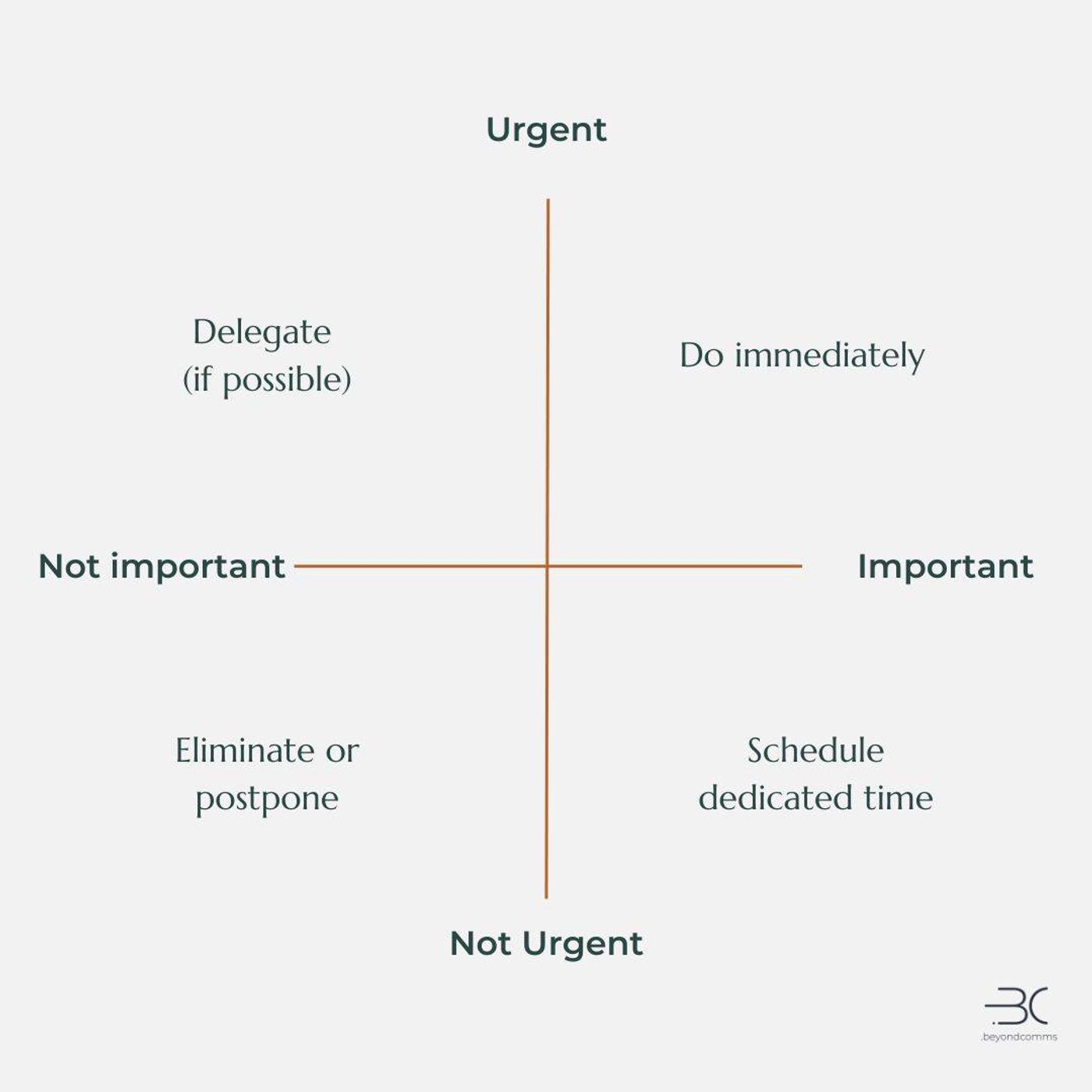
For communications specifically, consider these questions:
Which communications directly impact revenue or key relationships?
What messages must go out during this specific timeframe?
Which audiences are most critical right now?
What content can be simplified, repurposed, or postponed?
Remember: saying yes to one thing means saying no to something else. During busy periods, it's better to do fewer things well than many things poorly.
When you know busy periods are coming (and they always do), preparation becomes your greatest ally:
Create content banks: Develop evergreen content that can be deployed when you're too busy to create from scratch
Establish templates: Design reusable formats for common communications like updates, announcements, or follow-ups
Build modular content: Create pieces that can be mixed and matched for different channels and purposes
Automate what you can: Schedule social posts, email campaigns, and other predictable communications
During especially busy times, you won't have the bandwidth to be as nimble or responsive as usual. Having systems in place ensures you maintain your presence even when your attention is divided.
No matter how busy things get, set aside time to evaluate and strategize - this applies to your personal life too - whether you are in a relationship or have friends, set aside time to spend with them.
It might seem counterintuitive, but scheduled pauses become even more critical during hectic periods:
Block 30-minute weekly reviews: Assess what's working, what's not, and what needs adjustment
Schedule strategic breaks: Even 15 minutes of focused reflection can prevent weeks of misaligned effort
Create meeting-free zones: Designate time blocks where you can execute without interruption
This principle extends beyond business. No matter how busy things get, set aside time for the people who matter in your life. Maintaining these connections not only supports wellbeing but often provides the perspective needed to make better business decisions.
During extremely busy times, creativity sometimes needs to take a backseat to consistency. That's completely fine.
Trust is built through reliability, not necessarily novelty. Your audience would rather hear from you regularly in a simple format than sporadically in elaborate ones.
Some practical approaches:
Simplify your message: Focus on one clear point rather than complex narratives
Use proven formats: Rely on content structures that have worked before
Maintain voice and tone: Even simplified content should sound like your brand
Communicate transparently: If you're scaling back temporarily, consider letting your audience know
Remember that consistency builds trust, while silence creates uncertainty. Finding sustainable ways to maintain your communications presence - even in simplified form - preserves the relationships you've worked so hard to build.
During peak seasons, perfectionism becomes your enemy. Embracing "good enough" isn't settling - it's being strategic about where you invest your limited energy.
Ask yourself:
Is this communication serving its core purpose?
Does it maintain our standards for accuracy and clarity?
Will our audience get what they need from it?
If you can answer yes to these questions, the communication is likely ready to go, even if it's not your most creative or polished work.
Busy periods will always be part of business life. By embracing seasonality, prioritizing ruthlessly, planning ahead, pausing intentionally, and focusing on consistency over creativity, you can maintain effective communications even during the most hectic times.
What strategies do you use to maintain your communications during busy periods? Reply to this email and let me know.
From the .beyondcomms writing archive. References to offers, events and the practice reflect the time of writing.
Hi reader,
Picture this: You're a founder with a brilliant idea that has the potential to change the world. You know what you want to do. You have a product or service already and are making decent money. But when Monday morning arrives, you're paralyzed by questions:
Should you send pitch decks to investors? Bootstrap the next phase? Open a revenue stream? Target B2B clients?
Every option feels equally important and urgent. The overwhelm is real, and decision paralysis sets in.
This was exactly the situation facing a founder I worked with recently. They had passion, expertise, and a genuine desire to create positive environmental impact. What they lacked was clarity on which path to take first.
Most founders start with missions that sound impressive but provide zero practical guidance. Statements like "making the world a better place through land regeneration" or "changing agricultural practices toward sustainability across the world" sound noble, but they don't help you decide what to do on Tuesday afternoon.
Here's what I've learned from working with dozens of founders: A mission doesn't need to be grand and world-changing. It needs to be unique, personal to your brand, and specific enough to guide decisions.
The founder and I worked together to transform their broad purpose into something actionable: "We connect companies and communities to fund people-centered projects that heal the earth."
Was it still somewhat broad? Yes. But notice the specificity that emerged:
Who: Companies and communities
What: Funding mechanism
How: People-centered projects
Why: Healing the earth
With that, the path forward became clear.
With this refined mission, every business decision became straightforward to evaluate. Instead of wondering whether to pursue investors, bootstrap, or chase B2B clients, the founder could ask: "Which option best serves our mission to connect companies and communities for people-centered earth healing projects?"
The answer? Building relationships came first. The mission pointed directly toward reaching out to existing connections and pitching current projects. This single insight generated a wealth of focused marketing activities and engagement strategies.
The transformation was remarkable: from complete overwhelm to clear strategic direction, all through the power of a properly defined mission.
Think of your mission statement as a filter that sits between you and every business opportunity. Before any significant decision, ask yourself: "Does this advance our specific mission, or does it dilute our focus?"
This isn't about saying no to everything - it's about saying yes to the right things with confidence.
When directing a play, I know audiences can only focus on one thing at a time. If you try to emphasize everything on stage, nothing stands out. The same principle applies to your business: specificity creates impact.
In music, I learned that some notes must be emphasized while others are sung softer to help amplify impactful harmonies. Your mission helps you identify which business activities deserve emphasis and which should remain in the background.
The biggest objection I hear from founders is: "Okay, Sebastian, I have a mission statement. Now what? How does this practically work in my day-to-day business?"
Here's your practical framework for turning mission into a decision-making tool:
1. The Mission Lens: Before any significant decision, pause and ask: "If we pursue this opportunity, will it advance our mission or dilute it?" If you can't clearly connect the opportunity to your mission, it's likely not aligned.
2. The Resource Allocation Check: Your mission should guide where you invest time, money, and team focus. Ask: "Of all the ways we could spend these resources, which option most directly serves our mission?"
3. The Team Alignment Question: When your team proposes ideas or initiatives, evaluate them by asking: "How does this connect to our mission, and how will it help us better serve that purpose?"
Here's something most business advisors get wrong: they treat mission statements as permanent fixtures. In reality, your mission can and should evolve as your company grows. Pádraig Ó Céidigh, founder of Aer Arann, spoke about this eloquently on Gary Fox's podcast.
The key is being intentional about these changes rather than letting mission drift happen accidentally. As you gain clarity about your market, your capabilities, and your impact, your mission may become more specific or shift focus. That's not failure - that's strategic evolution.
This week, take 15 minutes to examine your current mission statement (or create one if you don't have one). Ask yourself:
Does it address a specific, burning problem?
Is it unique to your brand and approach?
Can you use it to evaluate business opportunities?
Would it help a team member make decisions when you're not around?
If you answered no to any of these questions, you have work to do. But here's the exciting part: that work will simplify every business decision that follows.
The path from overwhelm to clarity isn't about having fewer choices - it's about having better criteria for making those choices. Your mission, when properly defined, can become the most powerful simplification tool in your business toolkit.
What decisions are you facing right now that could benefit from this kind of mission-driven clarity?
From the .beyondcomms writing archive. References to offers, events and the practice reflect the time of writing.
Hi reader, I've been thinking about Ariana Grande lately.
Not her music specifically, but her journey. She is well known for her ability to mimic other celebrities like Celine Dion and Britney Spears - studying their techniques, copying their vocal runs, and learning their interpretative choices. For Ariana, this isn't theft, it's artistic education. A light and sweet tone characterizes her distinct vocal style now. She skillfully uses what she learned from other stars to inform her own authentic expression.
The same pattern exists in business, but most founders get stuck in the mimicry phase and never evolve to find their unique voice.
Humans are mimetic beings by nature. We learn through copying. In the arts, we follow exactly what the composer wrote before we dare add our interpretation. In business, we study what works before we attempt to innovate.
This is healthy. Necessary, even.
The trap isn't the mimicry itself - it's treating mimicry as your saving grace. The belief that "if it worked for them, it should work for me" becomes a substitute for the harder work of understanding why it worked and whether those conditions apply to your unique context.
I see this pattern with founders across continents:
Month 1: Launch with authentic passion and a clear vision
Month 6: Notice competitors who seem more successful
Month 12: Adopt their pricing, messaging, and tactics
Month 18: Wonder why everything feels forced and unnatural
When founders fall into harmful mimicry (copy-pasting competitors' approaches without filtering them through their own mission) the costs compound quickly:
Lost revenue from unclear positioning.
Slower sales processes because differentiation is muddy.
Less brand recognition because you sound like everyone else.
Misguided internal decisions because you're following someone else's compass.
But perhaps the most telling cost is internal: you get bored by your own work.
When everything feels like daily drudgery and nothing seems to move forward, when there's a certain idea fatigue that permeates your days - that's your authentic voice trying to break through the imitation.
Ready to break free from copycat marketing and find your authentic outbound voice? Join me and 7 other experts at the Outbound Summit 2025 on June 18th, where I'll be sharing "Resonant Brands that Sell Themselves" - the framework that helps you magnetize attention without the mimicry trap. Secure your spot here
In the early 2000s, Yahoo had something distinctive: a curated web directory that helped people navigate the emerging internet. But when Google's algorithmic approach gained traction, Yahoo felt threatened and tried to copy the search giant's methodology.
The result? Yahoo lost investor confidence and developed a reputation as "second-rate Google." They abandoned what made them unique in favor of mimicking what made others successful.
The lesson isn't that competition analysis is bad. It's that mimicry without mission clarity leads to losing what made you valuable in the first place.
Consider Stewart Butterfield's approach with Slack. Early on, the temptation was to follow the playbook of existing team communication tools - utilitarian, enterprise-focused, and joyless to use.
Instead, Butterfield made radical, mission-driven choices:
Witty, human copy that had personality
Consumer-grade UX in an enterprise product
Focus on pure team communication rather than feature bloat
Bottom-up adoption strategy instead of IT-department sales
The result? Slack grew from zero to $1 billion valuation in under two years, eventually selling to Salesforce for $27.7 billion.
What changed for Butterfield? He stopped looking sideways at competitors and started trusting what made Slack delightful, not just functional.
Here's what I've learned working with founders who successfully break out of copycat mode:
Mission clarity doesn't prevent you from learning from others. It provides a filter for applying what you learn.
When a recent client noticed a competitor's video guides performing well, we didn't simply copy the content and style. We applied their mission filter: What are the broad concepts at play? How does this apply to our unique approach? What needs to change to make it authentically ours?
The resulting videos used similar structural concepts but were unmistakably theirs in voice, perspective, and execution.
The path back to authentic voice requires deep listening - not just to what people say, but to what they don't say. To the moment someone starts to speak, then changes their mind. To the pause before they answer a question.
It's in these gaps that you discover what truly matters to your audience, what brings you genuine energy, and where your mission intersects with market need.
This listening happens best away from technology. With a pen and notebook, ideally in nature. Ask yourself:
Why did you start this venture?
What brings you and your team the most joy?
If no one was watching or reading, what would you want to say?
How does your audience connect with you most naturally?
The distinction between learning and losing yourself comes down to this:
Healthy mimicry: Critical thinking about concepts that work for you. Testing strategies through your brand lens. Listening to internal and external signals about what resonates.
Harmful mimicry: Copy-pasting tactics without understanding. Slapping your branding on someone else's approach. Pushing strategies that don't feel right because "they should work."
You know you've found your authentic voice when outreach becomes more natural, connections feel easier, and rejection becomes bearable because you know it wasn't the right fit.
Externally, people sense your positive energy. They can tell you're speaking your truth rather than reciting someone else's script.
Internally, the work energizes rather than drains you. You feel the burning urge to create something that comes from you, not from what others tell you to do.
In classical music, there comes a moment when you've learned all you can from following the composer's exact notation. When technical mastery creates space for interpretative choice. When you transition from performer to artist.
The question every founder must ask: Have I learned enough from others to trust my own voice?
Your authentic differentiation isn't hiding in your competitor's strategy. It's waiting in the space between what you've learned and what only you can create.
From the .beyondcomms writing archive. References to offers, events and the practice reflect the time of writing.
Hi reader, "I've been watching your videos."
That's how a recent sales call started for one of my clients - a legal services firm specializing in high-net-worth individuals. Not with the usual "Tell me about your company" or "What services do you offer?" but with immediate recognition and familiarity.
The prospect had been following their content for months. By the time they booked the call, the firm wasn't explaining their expertise - they were simply discussing how to move forward together. What used to be 3-month sales cycles became a 1-month decision.
The shift? They stopped chasing and started shining.
Most founders approach outbound like a fishing expedition - casting wide nets, hoping something sticks. But what if instead of chasing prospects, you could attract them?
This is what I call the Lighthouse Principle. Just as a lighthouse doesn't chase ships but positions itself clearly to guide those who need it most, your brand should create recognition before sending that first message.
The lighthouse doesn't shout or compete with other lights. It stands firm, shines consistently, and becomes unmistakable to those who are looking for a safe harbor.
Here's what changed for my legal services client: Instead of cold emails explaining who they were, they spent three months consistently sharing their expertise on investment migration and wealth diversification. Not generic content, but their specific point of view. We then amplified this with paid advertisements to reach even more people.
The transformation wasn't just in response rates - it was in the quality of conversations. When prospects already understood their approach before the first call, discussions moved from "Why should I trust you?" to "How would we work together?"
This is the power of operating from clarity rather than desperation.
Ready to build your lighthouse? Join me and 7 other experts at the Outbound Summit 2025 on June 18th, where I'll be sharing "Resonant Brands that Sell Themselves" - the framework that helps you magnetize attention without the mimicry trap. Secure your spot here
In my work helping founders move from reactive communication to purposeful direction, I've observed that memorable brands consistently communicate three key ideas:
1. Their Unique Perspective What do you believe about your industry that others don't? What's your distinctive take on the problems you solve?
2. Their Specific Audience Who exactly benefits from your unique perspective? Not "everyone who needs X" but "the specific type of person who thinks about X this way."
3. Their Clear Promise What transformation do you create? What does life look like after working with you?
These aren't marketing messages - they're the foundation of every interaction, every piece of content, every conversation you have. When these three elements are clear and consistent, you stop blending into the marketplace noise and start standing out as the obvious choice for your ideal clients.
Before you write another cold email or book another discovery call, take time to establish your foundation. Here's a simple exercise I use with clients:
The Listening Practice (10 minutes):
Set a timer for 10 minutes
Write continuously about why your work matters - not what you do, but why it exists
Don't edit, just write
Notice what themes emerge when you're not trying to "sell"
The Definition Practice (15 minutes):
Complete this sentence: "I help [specific type of person] who [specific situation/belief] to [specific transformation] through [your unique approach]"
Refine until it feels true, not just marketable
Test it: Would someone hear this and immediately know if they're your person?
This isn't about perfect messaging - it's about clarity. When you're clear on these foundations, every piece of outreach becomes an extension of your lighthouse signal rather than a desperate attempt to get attention.
In classical music, we talk about resonance - the way certain notes naturally amplify and carry further than others. The same principle applies to your positioning. When your message resonates with your ideal audience's existing thoughts and needs, it travels further with less effort.
This is why my client's videos worked. They weren't shouting louder than competitors; they were resonating at exactly the frequency their ideal clients were already tuned to hear.
On June 18th, I'll be joining an extraordinary group of outbound experts at the Outbound Summit to share exactly how to build "Resonant Brands that Sell Themselves." While other speakers will be covering the tactical execution of outbound - how to write emails that get replies (Talica Davies), magnetic messaging for social selling (Tara Lassiter), and discovery frameworks that convert (also Talica) - my workshop focuses on the foundation that makes all those tactics more effective.
You'll leave with:
A clearly defined mission that attracts your ideal audience
A strong overview of who your perfect clients are
The confidence to communicate your unique value consistently
Because here's what I've learned working with founders across three continents: The most effective outbound isn't about better scripts or clever subject lines. It's about being known for something specific before you ever hit send.
The founders and consultants who are winning with outbound aren't the ones with the most sophisticated sequences or the largest lists. They're the ones who've done the foundational work to become recognizable in their market.
They've built their lighthouse. They shine consistently. And when they do reach out, prospects don't think "Who is this?" They think "I've been waiting to hear from you."
The Outbound Summit isn't just about tactics - it's about transformation. Join me and six other experts on June 18th to build the foundation that makes every outbound strategy more effective.
Register for the Outbound Summit here - Because your market is waiting for your lighthouse to shine.
What lighthouse will you build?
From the .beyondcomms writing archive. References to offers, events and the practice reflect the time of writing.
Hi reader, last week, I had the pleasure of chatting with Kristen Holley on a LinkedIn Live. Kristen is an accomplished professional who works with companies on change management.
The premise of the conversation was - how do you know that your communications are actually landing? There is so much noise, and people are drowned by thousands of messages. Therefore, we wanted to explore different principles and approaches that allow us to evaluate the effectiveness of our communication campaigns.
If you missed the chat, you can view the livestream on my LinkedIn page. For this week, let's dig into three principles that apply across internal and external communications.
The first mistake most founders make is believing that saying something once, or even twice, is enough.
Your audience won't absorb your message on the first encounter. Do you pay attention when you see an ad or a social post once? I didn't think so. Your audience is the same; they probably won't even notice it on the second or even fourth time. This isn't about short attention spans or the impact of 5-second reels on our psyche; it's about the cognitive reality of how we process information in an oversaturated environment.
Strategic repetition means communicating the same core message across different channels, but adapting the format and context for each platform. Your mission statement might appear as a story in your newsletter, a behind-the-scenes post on social media, and a case study on your website. Each instance reinforces the same fundamental truth about your business.
The key is consistency of your message with variation in presentation. When your audience encounters your core messages multiple times across different contexts, recognition builds into understanding, and understanding builds into trust.
No matter how much blood, sweat, and tears you put into getting your message across to your stakeholders, it will always carry more weight when someone else talks about you than when you talk about yourself. Think of how effective endorsements and testimonials can be.
This is where strategic relationship-building is crucial. Champions aren't just customers who'll give you testimonials - they're people who understand your mission so deeply that they naturally advocate for your approach.
These champions exist within your network already. They might be clients who've experienced transformation through your work, colleagues who've witnessed your unique approach, or even team members who embody your values daily.
The strategic opportunity lies in identifying these natural advocates and ensuring they have the language and context they need to represent your message accurately. When someone they trust speaks about your work, your message travels further and lands deeper than any amount of self-promotion could achieve.
Do you want to build the foundation for resonant communications? Join me and 7 other experts at the Outbound Summit 2025 on June 18th, where I'll be sharing "Resonant Brands that Sell Themselves" - the framework that helps you magnetize attention without the mimicry trap. Secure your spot here
Perhaps the most powerful principle is also the most counterintuitive: stop trying to control exactly how people talk about your business.
Instead, listen carefully to how your champions and satisfied clients naturally describe their experience with you. The language they use, the problems they say you solved, the transformation they attribute to your work - this is your message reflected back through their experience.
This echo principle reveals something crucial: when your mission is clear and your delivery consistent, people will naturally find language to describe the value you provide. Your role isn't to script their conversations but to listen for the patterns in how they describe their experience.
These descriptions often reveal aspects of your value that you might not have articulated clearly yourself. They become the foundation for more resonant messaging because they're grounded in real experience rather than internal assumptions.
These three principles work in harmony. When you repeat your core message consistently across channels, you create multiple touchpoints for potential champions to encounter and understand your work. When champions authentically advocate for your approach, they create echoes that reveal how your message truly lands. When you listen to these echoes, you refine your understanding of your own value proposition.
This isn't about manipulation or marketing tactics. It's about creating genuine alignment between your mission, your communication strategy, and your audience's experience.
This alignment is essential for any business. Your unique value proposition deserves to be heard clearly, and your ideal clients deserve to understand exactly how you can serve them. These principles ensure that your message doesn't just reach your audience - it resonates with them.
What echoes are you hearing about your business that might surprise you? I'd love to know what language your clients use to describe their experience with your work.
From the .beyondcomms writing archive. References to offers, events and the practice reflect the time of writing.
Hi reader, how do you know whom to trust anymore? AI-generated content is rampant on our social feeds and search engines. Midjourney and OpenAI are entangled in intellectual property rights battles for their models using artists' protected work to generate facsimiles and 'inspired copies.'
This trust recession started much longer ago. I recently received an email from a 'professional review writer' offering their services to write great reviews on platforms such as TrustPilot and Clutch. These practices have been going on for years.
In a world where companies and individuals with big pockets can pay for 'credibility', how can we build and maintain trust without fake reviews and unethical practices?
From a brand's perspective, there are multiple ways to build trust. If you need to build it quickly because you're launching or need to raise funds, you can do some of the following:
Strategic partnerships - build affiliations with brands or individuals who can support your offers. Leverage trust that already exists
Programs, incubators, grants - get a 'seal of approval' from a funding program or grant-giving body
Testimonials - if you have existing clients or even friends who can endorse your work, put that all over your feed and website. Show that real people have gotten real benefits from your solution
Press Coverage - reach out to journalists and writers to get your business or ideas covered - this will build credibility
For the long-term, you should consider some the following activities and plays:
Accreditations - depending on your industry, you might be required to have certain certificates (e.g. ISO, etc)
Professional memberships - joining a chamber of commerce or other networking groups can be a great way to show that you have skin in the game and operate as part of a larger ecosystem
Show up consistently with your brand - make sure that you choose spaces where you can show up consistently, your audience won't forget you, and your brand will be perceived as reliable and present
The longer you are in business, the easier it will get - customers feel that a business that's been around for 10 years must be doing something right
We all know that building trust takes years. While losing it will only take seconds. One of the biggest drivers for your audience to begin to trust your brand is cohesion across your different assets and teams. If your payment page doesn't look like your landing page or flyer, you might lose your buyer - or you'll have some explaining to do.
If your sales team communicates with your customer, saying that everything will be easy and quick, and then your operations department comes in with different timelines and complications, your brand has lost some credibility.
If you want to maintain trust and credibility, make sure that small details like logo visibility, cohesion across communication, and the look and feel of assets along the customer journey are similar.
That's all for this week, some shorter Sunday thoughts. What have you found particlularly useful and building trust for your brand? Reply to let me know.
From the .beyondcomms writing archive. References to offers, events and the practice reflect the time of writing.
Hi reader, let's be honest - most mission statements suck. They might sound great and make us feel warm and fuzzy, but when looking at the day-to-day, they are nothing but a few nice words on a page.
This week, we'll look at creating a mission statement that propels your company and team forward.
Most of the founders I speak with start their businesses because they want to make their world a better place. They find a problem and a solution they can provide. Plus, the potential for income is tantalizing, and the basic economics make sense. So, they go on to create the basics of their brand.
Everyone (read the nameless masses of the internet) says a mission statement is crucial for a company, so they set out to write a few pretty words on a sticky note.
Let's look at some examples:
1) We’re committed to delivering traceable, science-backed ingredients that support your health 2) We exist to make well-designed products and tell stories that inspire 3) Help create an Ireland where young people aged between 16 and 25 are empowered with the information they need to live active, happy, and healthy lives
They all sound very important. But they are vague and unspecific. They could belong to any brand in their respective industries. Let's look at the questions that are left open in each:
1) What kind of health is this brand focusing on? What audience do they serve? How do they do this - research, actually creating the ingredients? 2) What kind of products? This brand could be making shoes, make-up or even building materials. 3) How is this information delivered? This could be government advocacy or grassroot community workshops and everything in between.
A mission is meant to guide the company and its stakeholders toward a shared goal. It needs to do a few things at once: 1) inspire, 2) guide, 3) activate
In order to do so, the statement should be concise, specific, and actionable. We have a formula for this at .beyondcomms that is meant to keep us and our clients honest:

Action→ this is what you do. Be specific here. Don’t write ‘we aim to …’; ‘we help…’ or vague statements of this sort. Write, ‘we build websites’; ‘we manufacture…’ Choose strong active verbs
Impact → describe what impact you want to have and on whom. Again specificity is key. Writing ‘make the world a better place’ isn't good enough. Make this specific to your audience, e.g. ‘inspire underrepresented youth to define success’
Vessel → this is how you are delivering the impact and action. This could be a specific product or service, e.g. communications consultancy or online courses, or something a bit more vague if you have multiple business verticals.
The action you choose is one of the most important aspects of your mission. This will guide your team on how they execute their tasks and initiatives. The impact is equally important. You need to specify here exactly who you want to impact and how. This is the moment where you can be very clear on your target audience.
Unless you already have recognizable brand that makes it very clear what you do, it is important to include your vessel - the way you deliver your services or what kind of products you create - in your mission statement.
If you follow the formula above, you should end up with a pretty solid statement. For example, .beyondcomms' mission is to "Craft creative spaces and strategies for founders and businesses to gain clarity on their communications and create authentic connections through their brands."
Test your mission: If can put it underneath any competitor's logo, it's not specific enough.
Start with a verb: begin with a strong and specific verb.
Be specific: Don't be afraid if the statement is a bit longer at the beginning, prioritize specificity over length.
Do you want to get feedback on your current mission statement to see if it could be improved? If you send your mission statement to me within the next seven days, I'll respond with some high-level notes.
From the .beyondcomms writing archive. References to offers, events and the practice reflect the time of writing.
Hi reader, last year, I watched a founder spend five figures on a brand recognition campaign that generated thousands of impressions but zero meaningful connections. The visuals were polished, the messaging was clear, but something fundamental was missing. When we spoke about the transformation they wanted people to associate with their brand - silence.
I was reminded of this when looking at KitKat's success. They've been around for 80 years, and everyone knows 'Have a Break, Have a KitKat.' That's the recognition many want.
But here is the deeper lesson, KitKat's recognition only partially comes from longevity and clever slogans, a massive driver comes from solving a genuine human need through purpose-driven positioning.
Most people analyze KitKat's success through the wrong lens. They see the tagline, the distribution, the decades of marketing. What they miss is why "Have a Break" worked in the first place.
KitKat didn't start by trying to build brand recognition. They started by identifying a specific human need: workers wanted a small, portable snack they could enjoy during their tea break. This wasn't market research - it came from a factory worker's genuine frustration with available options.
Their entire brand strategy flowed from this purpose: to give people permission to pause. Every marketing decision, from positioning it as a tea accompaniment to the eventual "Have a Break" campaign, reinforced this single transformation.
Here's what most businesses miss: KitKat's recognition came from consistently delivering on a promise that mattered to people's daily lives. They weren't selling chocolate; they were selling the cultural permission to rest.
Your clients don't need another company with 80 years and unlimited marketing budgets. They need to understand the principle that made KitKat work: recognition follows when you consistently align your business around a transformation people actually need.
The businesses that achieve lasting recognition today follow the same pattern:
They identify a specific transformation their audience craves
They align every business decision around delivering that transformation
They communicate consistently about the outcome, not the features
They give people permission to want what they're offering
KitKat gave people permission to take breaks. Patagonia gives people permission to prioritize the planet. Apple gives people permission to think differently.
What permission does your business give people? What transformation do you make possible? That's your path to recognition that matters.
Start with Transformation, Not Tactics Before asking "How can more people see us?" ask "What change do we create that people genuinely need?" Your recognition strategy should flow from this answer.
Find Your Permission Statement KitKat: "It's okay to pause and recharge" What does your business give people permission to do, think, or feel? This becomes your recognition anchor.
Align Every Touchpoint Once you know your transformation, ensure every communication reinforces it. KitKat didn't just advertise breaks - their packaging, portion size, and even product name supported the pause narrative.
Choose Depth Over Breadth KitKat focused intensely on the tea break moment rather than trying to be relevant for every snacking occasion. Similarly, focus on being deeply meaningful to your specific transformation rather than broadly appealing to everyone.
Measure Recognition Through Resonance True recognition isn't about recall metrics - it's about association. When people face the challenge you solve, do they think of you? That's the recognition that drives sustainable business growth.
KitKat's 80-year success story isn't about time or budget - it's about purpose-driven consistency. They identified a transformation people needed, aligned their entire business around delivering it, and communicated about the outcome consistently for decades.
You don't need 80 years to build meaningful recognition. You need clarity about the transformation you create and the commitment to align everything around delivering it consistently.
What permission does your business give people? The answer to that question is your path to recognition that matters - not because people see you everywhere, but because you matter to them when they need what you provide.
From the .beyondcomms writing archive. References to offers, events and the practice reflect the time of writing.
Hi reader, we are a little over halfway through 2025. I'm writing this week's issue during my period of strategic reflection. As someone who helps founders create clarity in their communications, I've been forced to apply my own medicine - and the results have been both humbling and illuminating.
This year began with big founder ambitions on my side: aggressive growth targets, expansion plans, and new service launches. But as we approach the birth of our first child, I've been confronting a fundamental question that I pose to every client: Is your business strategy aligned with your core values?
The honest answer was no.
I had been building .beyondcomms based on what I thought growth should look like rather than what sustainable success means for my family and values. This misalignment was creating exactly the kind of reactive, scattered approach I help my clients avoid.
So I made a choice that goes against every growth-hacking playbook: I deliberately slowed down.
Last week, I drove our dog to my parents in Germany. This 27-hour road trip across six European countries gave me a lot of time to reflect. When I focused on the final destination which was still 20+ hours away, every traffic jam felt like failure. But when I focused on the next charging station, the next 2-3 hour segment, the journey became manageable.
This mirrors the most common communication mistake I see founders make. They fixate on massive outcomes (€1M revenue, viral content, industry dominance) while ignoring the incremental milestones that actually build sustainable brands.
Your audience doesn't connect with your grand vision - they connect with your next logical step. Your team doesn't rally around eventual success - they rally around clear, achievable progress.
Working with founders across three continents, I've noticed a pattern: companies that communicate from strategic clarity consistently outperform those stuck in reactive growth mode. Yet most founders I meet are caught in what I would call "growth theater" - pursuing metrics that look impressive but don't align with their core mission.
Instead of "How do we get more followers?" ask "How do we deepen connection with our ideal audience?"
Instead of "What content will go viral?" ask "What message consistently represents our values?"
Instead of "How do we scale faster?" ask "How do we scale sustainably?"
When your business actions align with your stated values, something powerful happens: your communications become effortless because they're authentic. Your team makes consistent decisions because they understand the mission. Your ideal clients recognize you immediately because your message is clear.
This isn't about slowing down for the sake of it - it's about ensuring every action compounds toward your actual goals rather than someone else's definition of success.
As you navigate your own halfway point of 2025:
Are your current business activities aligned with your stated mission and values
What's the next meaningful milestone that would genuinely advance your purpose?
When did you last create space to reassess whether you're building the business you actually want?
Sometimes the most strategic thing you can do is pause and ensure you're heading toward a destination that matters to you.
Moving forward, I'm recommitting to our core mission: creating spaces for founders to gain strategic clarity about their communications. This newsletter continues weekly, the podcast The Arts in Business returns monthly, and my client work will deepen rather than expand.
The difference? Every decision now filters through our values of sustainability, depth, and authentic connection rather than growth metrics that look good on LinkedIn.
Your business doesn't have to follow anyone else's timeline. The bravest strategic move is often defining success on your own terms and communicating that clarity to everyone around you.
What's one area where you need to slow down to speed up? Reply and tell me - every response helps me understand how to better serve this community.
From the .beyondcomms writing archive. References to offers, events and the practice reflect the time of writing.
Hi reader, there is a trap that too many leaders fall into - mediocrity.
Stuck with shame about money, fear of commitment, or chasing shiny objects, these leaders build businesses that plateau. This is not to say that mediocrity is bad, but I know that you are leaders who pursue excellence.
You have built businesses based on strong convictions and purpose.
Let's explore how you can avoid falling into this trap.
My theatre professor, Ruben Polendo, used to say (and I quote liberally): "You have to be the first person to care about your work. If you don't care, why would anyone else?" This has become one of my most fundamental guiding principles in art.
The same applies to business: if you don't deeply care about what you are offering, why should your audience?
This is the first point of failure where things can go wrong. You need to be very clear on your mission and why you do what you do. If it's about just making as much money as possible, so be it.
Be honest about it and embrace it.
If you have another reason that supercedes profit, then uncompromisingly lean in.
If you've ever been employed or worked for someone else, you can turn this around as well. The team of a manager or a boss who didn't really care much about their work most likely performed worse than others.
Why? because they had no reason to assign importance to their work.
You've probably seen a movie or a play in which the acting was just unbearable. So bad that no direction, lighting, writing, or special effects could have saved it.
Often, the reason for this is a lack of commitment to their choices.
For example, the actor decides that their character is motivated by a deep yearning to be loved and accepted, but then when they act in a scene, they turn their motivation into getting their scene partner's approval. They commit only halfway.
While the audience might think: "oh that was nice," they won't have a strong connection to the moment.
A while ago, I worked with a client who had a brilliant idea and such a strong purpose for why they were building their business. They were ready to change the world with the potential to change the lives of many communities. However, they weren't committed to making a choice.
Instead of sticking to one vertical in their business, they tried to work on three at the same time. They had built a great platform, but then wanted to pivot to a product-based offering.
The lack of commitment cost them time and a lot of money.
When you are making a strategic choice in your business, commit to it for at least three to six months. Your strategies need time to play out and your strategies deserve the time to prove themselves in the market.
I was stuck in between two truths for a long time in my business. Frankly, that set me back by at least one year and cost me at least € 30k in revenue.
I started .beyondcomms out of a 'deeper purpose.' I wanted to change the world and how businesses communicate. It was a noble mission that made me feel great. But that was it.
I didn't want to acknowledge the economic realities of running a business. I always thought that I needed to hide the fact that I want to make money. I had a lot of shame around making money, and a lot of internal judgment against profit-first businesses.
I was living between two truths: my perceived deep purpose and the reality that I was running a business that needed money.
I don't want to be super rich through my company, but I want to make enough to live a good life and give the people who work with me a good life too.
I was ashamed to put money more into the center and make it an actual part of my mission. I thought that it needs to be hidden behind a grand aim to make the world a better place - but really, I needed to acknowledge that it's a reality. It's not part of my mission now, but it is a key decision-making factor.
If I don't make money with something or through a service, I will have to say no.
Don't fall into the same trap. Own your profit purpose and make choices accordingly.
Profit can lead to great potential for more impact.
If you commit to a purpose other than profit, make sure that you don't discount the importance of money and (at least) revenue. We don't live in a society in which we can easily trade goods with each other. Money is necessary.
Act accordingly.
If you want to identify if you are in danger of creeping toward mediocrity, here is an exercise I do with my clients at the very beginning of our work together. We look at perception vs reality.
Here is how it works:
1) Start by writing down your purpose and your vision for the organization
2) Then compile a list of daily actions you and your team do (we usually do this through stakeholder interviews and deep listening sessions)
3) In the last step, compare the two
You need to be brutally honest at the end of the exercise. Most clients here realize that their words and actions are misaligned. What they say is not what they do.
Often, what they do is actually indicative of what they should say.
If you want to take a concrete step into action as you start the new week, try this:
Write out your mission in plain words.
For example, "we want to make a shit-ton of money so that we can be rich and share the wealth with everyone else."
Then share it with your circle of trusted people. Or, if you want to be really bold, send it to your team and invite open dialogue.
At the end of the week, you can identify inconsistencies, and we will look at fixing them in our next Shot of Purpose.
If you want any help with this, schedule a strategy call with me. We'll have 90 minutes together to workshop your biggest blocker and develop an actionable plan for you.
From the .beyondcomms writing archive. References to offers, events and the practice reflect the time of writing.
Hi reader, it took me 18 months to learn a painful lesson about trust.
I had my manager's wholehearted support for a promotion request. They promised to fight for it, assured me it would happen. But for months, nothing moved. When it finally came through, it was a lower level than I'd requested and a salary increase that barely matched the rate of inflation and the appropriate compensation for my actual responsibilities.
Meanwhile, I watched others get promoted around me. Executive positions were being filled. The organization constantly promoted their "world-class standing" and commitment to "inclusivity." But when it came to aligning their words with their actions, there was a massive gap.
The final outcome? I left my job.
What I've learned working with organizations since is that this disconnect between words and actions isn't usually malicious. Most leaders genuinely believe they're living their stated values. The problem is they can't see their own word-action gaps. And fixing this requires uncomfortable, disciplined work.
Think about how musicians approach their craft. They don't just dream of playing beautiful symphonies, they practice scales every single day. Boring, repetitive exercises that slowly close the gap between their musical ambition and their actual ability.
Leadership requires the same discipline. Every day, leaders need practices that close the gap between their grand mission statements and their daily actions. Without this daily work, the disconnect grows wider, trust erodes, and talented people walk away.
The business equivalent of practicing scales? Having conversations that immerse you in your team's and customer's reality. Speaking to your audience (both internal and external) to understand how your actions actually land, not how you intend them to land.
Here's the tool I use with organizations to reveal these gaps. It's simple, but it can be brutally honest. Create a three-column table:
Start with your mission statement and key values. Then add any declarative statements from your website or presentations.
For example:
We are an innovative workplace
We champion excellence and develop talent
We welcome the team's ideas and let them experiment
We create clear growth pathways for all employees
Ideas are heard in meetings but nothing is ever executed
Leadership positions get filled, but lower-level advancement stalls
This exercise reveals opportunities, not failures. Once you can see the gaps, you can address them head-on instead of wondering why trust feels fragile or why good people keep leaving.
The leaders who master word-action alignment don't just sleep better at night, they build more profitable organizations. Aligned teams make faster decisions, require less management oversight, and become genuine advocates for the mission. They increase earning potential because everyone is pulling in the same direction.
But here's what prevents smart leaders from seeing these gaps: overwhelm and ego. Overwhelm makes us reactive: we're so busy firefighting that we don't notice the patterns. Ego tells us everything is clearer than it actually is.
The antidote is empathy. Put yourself in your team's shoes. See your organization through their eyes, not your intentions.
Step 1: Create your three-column table. Be honest about both your mission and your values. Include any public statements your organization makes.
Step 2: Have at least one conversation daily that shows you a different perspective on your business. Talk to a team member about their experience, or ask a client what they actually notice about your organization.
This isn't comfortable work. You might discover gaps that challenge your self-perception. But closing these gaps is what transforms reactive organizations into purposeful ones.
The most successful leaders I work with understand that internal alignment is just as crucial as external marketing. You can't authentically communicate to the market what you don't genuinely embody internally.
What gap will your table reveal? I'd love to hear what you discover, every response helps me understand how to better serve this community.
From the .beyondcomms writing archive. References to offers, events and the practice reflect the time of writing.
Hi reader, we were sitting in the dark conference room at the other corner of campus. Four people stared at the whiteboard. The fifth person in the room, the PR consultant, spoke animatedly about the importance of this session - the great strategic potential we would unlock.
There we were, firing away our ideas, comments, and theses. It was an exercise in academic musings and idea 'vomiting'. The consultant congratulated everyone on their brilliance and promised their team would integrate the ideas into the next communications plan.
When the firm's contract was up for renewal, we decided to switch to someone else.
Nothing had worked, no ideas manifested. This wasn't just a consulting failure - it was a business failure that cost real money and time.
The problem with traditional consulting is a lack of empathy. Solutions and ideas are created in a vacuum. In conference rooms away from customers and clients. Often with leadership teams who don't interact daily with their audiences.
Frameworks like SWOT analyses, while useful in academic and theoretical settings, prime us to think not of the most outrageous ideas. They box us neatly into their quadrants and tables.
The results are removed from day-to-day reality and don't hold up in the market.
How do we break out of these sterilized spaces? We craft intentional creative spaces to activate empathy and insights that are begging to be unearthed. We use this technique at .beyondcomms for both physical and mental spaces.
The core idea draws from artistic practices - music, theatre, visual arts, writing. There is nothing like stepping into a dark rehearsal space, only to emerge to the land of the living after 3 to 4 hours of focused and intense work.
We use the concepts around boundaries and restrictions that have created some of the most incredible masterpieces in the world.
How does this work in practice?
For one of our clients, we created a mental space (we were working together remotely) through guided meditation and writing prompts. In the short span of 20 minutes, they were able to articulate ideas around their ideal audience they didn't have before.
They realized exactly who they didn't want to work with, and they found a whole new segment they hadn't considered before. In this writing meditation, they found important clarity. They realized they didn't want to work with international tourists but instead focus on urban Irish residents seeking escape. This clarity led to three targeted upsell packages and a complete repositioning of their marketing.
I was in Curry's yesterday, hoping that the store assistant could answer a question I had about a dryer. He pulled out his phone and asked ChatGPT. I got the same answer that my ChatGPT question had generated a few days beforehand. I was looking for expert validation, when perhaps, I should have immediately trusted AI's answer?
Artificial intelligence is making a vast amount of knowledge even more accessible, it's eroding critical thinking, and enables us to produce content, ideas, and concepts at neck-breaking speeds.
Here is what it cannot (yet?) replicate: human creativity. To generate something from nothing is a uniquely human ability. It's what will set human businesses apart from AI-generated money-machines.
Fostering our creativity and leaning into it in the context of business is already becoming a superpower that some brands are harnessing - from creating humorous campaigns to beating out competitors with their unique points of view and voices.
This is why creativity isn't just nice-to-have anymore - it's becoming essential for competitive differentiation.
How are you going to enhance your unique point of view?
Here are a few things that you can do to craft a creative space for yourself or your team:
Have your next meeting on blankets in a park
Instead of sitting at a conference table, meet in the kitchen
Go through a relaxing breathing exercise before your tackle your next piece of writing
Close your eyes and speak your ideas into the space
Try one or two next week to see if they can help you break through a blockage you're encountering.
What's your biggest strategic challenge right now? Reply and tell me - I'll send you a creative approach that could unlock new solutions for you.
From the .beyondcomms writing archive. References to offers, events and the practice reflect the time of writing.
Hi reader, my family's bakery survived Hitler, Stalin, and the collapse of East Germany. It couldn't survive the 2010s.
For over a century, the business weathered existential crises through clear purpose: serve the community, master the craft, adapt to survive. When my parents took over in the early 2000s, they had everything a business consultant would recommend - loyal customers, superior quality, diversified revenue streams, and genuine community connection.
What they didn't have was a communication strategy for a world where word-of-mouth alone wasn't enough anymore.
In a small German town of 16,000, my parents maintained their business the traditional way: through relationships, consistency, and reputation. Customers recommended them to neighbors. Quality spoke for itself. The family name carried weight across generations.
This approach sustained the bakery for decades. But it created an invisible ceiling.
While my parents focused on serving existing customers - delivering bread to elderly clients who couldn't leave their homes, maintaining partnerships with local kindergartens - their customer base was literally aging out. The demographic that sustained word-of-mouth marketing was disappearing, and they had no clear strategy to reach the younger generations who might replace them.
Opening a second branch near schools was smart strategic thinking - they recognized the need to reach younger demographics. But even with this expansion, the challenge remained: how do you communicate your value when supermarket chains offer similar-looking bread at a quarter of the price?
Here's what business books rarely tell you: superior quality without strategic communication is just expensive overhead.
My parents' bread was objectively better - traditional methods, century-old recipes, genuine craft. But when a family is choosing between a 40-cent roll and a 15-cent roll from Kaufland, quality becomes an abstract concept unless you can articulate why it matters.
The supermarket chains weren't just competing on price. They were communicating convenience, value, and modernity. My parents were communicating... nothing. They assumed their work would speak for itself.
In a small town context, this was partially reasonable. Multi-generational businesses were common. Tradition carried weight. The artisan craft brewery approach that works in Dublin or Berlin would have felt pretentious and out of place.
But even in traditional contexts, you still need to bridge the gap between what you offer and why it matters to people who have choices.
The strategic shift my parents needed wasn't about abandoning their values or becoming something they weren't. It was about translating their existing purpose into language that new generations could discover and connect with.
While they maintained a Facebook page and tried various communication approaches, the gap remained between their exceptional work and how new audiences could discover them. They experimented with different strategies but couldn't find the right balance between their authentic approach and the reach they needed.
They could have positioned themselves as "the family bakery that three generations of families have trusted" - emphasizing continuity and relationships rather than trying to compete on convenience or price.
Most importantly, they could have created digital bridges to people who valued what they offered but didn't know how to find them. Former customers who moved away. Young families looking for alternatives to mass-produced food. People who cared about supporting local businesses but didn't know which ones existed.
The challenge my parents encountered wasn't about lacking strategic thinking. It's that they were already living a story worth telling - they just needed to find the right ways to share it more broadly.
They had proof of concept spanning a century. They had customer loyalty that survived political upheaval. They had craft knowledge that couldn't be replicated by corporate chains. They had personal service that created genuine community connection.
But in a marketplace where attention is fragmented and choice is abundant, having a great story isn't enough. You need to share it intentionally, consistently, and in places where new audiences can discover it.
This isn't about choosing between tradition and innovation. It's about using modern communication tools to share timeless values with people who are looking for exactly what you offer.
My parents didn't need to become social media influencers or abandon their approach. They needed to document and share the purpose they were already living - just in formats that could reach beyond word-of-mouth networks.
The challenge that ultimately led them to close wasn't just from physical work. It was from the difficulty of making excellence visible and valued in a rapidly changing marketplace.
What are you surviving day-to-day that's preventing strategic thinking?
This week, take 15 minutes to honestly assess:
1) What word-of-mouth networks are you relying on that might be limiting your reach? Where are the people who would value your work but don't know you exist?
2) What story are you already living that you're not telling strategically? What makes you different that you assume people just "know" about you?
3) How could you communicate your purpose authentically without abandoning your values? What modern tools could amplify your existing approach rather than replace it?
Purpose-driven businesses don't fail because they lack purpose. They fail because they assume purpose communicates itself.
Your work matters. Make sure the right people can find it.
What communication gap is costing you the most right now? Reply to let me know.
From the .beyondcomms writing archive. References to offers, events and the practice reflect the time of writing.
Hi reader, yesterday I sat staring at a blank page for forty minutes. The cursor blinked. I had thoughts, fragments, half-formed insights about leadership and creativity swirling around, but nothing cohesive enough to send you.
So I didn't. But here you are, getting a short little musing at the beginning of the week.
This happens more than I care to admit. The gap between having something to say and finding the form to say it well. It's the same gap my clients face when they know their organization needs to change but can't articulate how. The same space where most strategic thinking dies, somewhere between intention and expression.
Last week, I had the pleasure of recording two new episodes for The Arts in Business. The podcast is made up of long-form, meandering conversations that center artists' practices and artists in businesses. It serves as a research platform to inform some of the practices in .beyondcomms.
One of my guests Fiona Delaney said something that's been haunting my thoughts: "I do think in art is struggle. I think struggle is a part of art, right? The struggle is intrinsic."
This landed differently than the usual business advice about "embracing challenges" or "persevering through obstacles." Fiona wasn't talking about struggle as something to overcome, she was describing it as generative material. The raw substance from which something new emerges.
We have to overcome struggle to move into a state of flow and creation. We have to embrace struggle and celebrate it to work with others. Without struggle, we wouldn't have revolutionary products and solutions like electricity, vaccines, technology, and so much more.
Most organizations treat internal resistance the same way they treat external competition: as something to defeat. But what if that resistance, the team member who keeps pushing back on the new strategy, the department that can't seem to align with the company values, the persistent customer complaints that seem to miss the point, what if that's not opposition but intelligence?
I am worried that we try to move away from struggle too much - automating every single action, using artificial intelligence to do our critical thinking, leaning too much on technology to help us disconnect with ourselves.
I want to acknowledge that I'm writing this from considerable privilege. I get to explore these questions from the safety of a business that works, in a country where intellectual curiosity is a luxury I can afford. For many in the world, struggle is a part of daily reality. Many don't have the luxury to turn to a piece of technology to feed their hunger or make their traumatic experiences go away. They have to live in fear to abandon their home or undertake heroic journeys to create better futures for their families.
When it comes to your business application, here's what I've observed working with leaders across three continents: the organizations that transform don't just solve problems - they develop a different relationship with the problems themselves. They create spaces where productive resistance can surface insights that smooth operations would never reveal.
The question isn't whether you'll encounter struggle in your work. The question is whether you've created the conditions for that struggle to generate something valuable.
What resistance in your organization have you been trying to eliminate that might actually be pointing toward something important?
How might your team's creative capacity change if struggle became material to work with rather than obstacles to overcome?
Where are you forcing solutions when you might need to first create space for the real problem to reveal itself?
This is messier than most business writing. It's supposed to be. The clean frameworks and five-step processes have their place, but they often skip the most interesting part - the generative confusion that precedes clarity.
If you're a leader who senses there's intelligence in the challenges your organization faces, I'd love to hear what you're discovering.
Last updated: 12 November 2026
BEYONDCOMMS LIMITED, trading as .beyondcomms, is a private company limited by shares registered in Ireland, number 735455. Our registered office is 11 Kingstone Manor, Delgany, Ireland. We are the controller of the personal data described here. For questions or requests, email hello@beyondcomms.io.
When you contact us, we receive the contact details, message and attachments you choose to provide. We use them to respond, arrange conversations, explore projects and manage our working relationships. Our legal basis is our legitimate interest in communicating with people interested in our practice and running our business. Where we take steps at your request towards a contract with you, or perform that contract, we rely on contractual necessity. We process records required by law to meet our legal obligations.
Providing information is voluntary, but we may be unable to respond or arrange work without sufficient contact details and context. Please avoid sending sensitive information or another person's confidential information unless necessary and authorised.
The contact form sends your name, email address, organisation (if supplied), enquiry topic and message to our company mailbox. It does not add you to a mailing list. We use a temporary session cookie to protect form submissions, and short-lived hashed network identifiers to limit spam. Message contents are not stored in a separate website enquiry database.
We use your subscription details to deliver the updates you request, based on your consent. Subscriptions are managed through Kit. You can unsubscribe using the link in an email or by contacting us. Sending an enquiry does not subscribe you to our newsletter.
Our newsletter service currently records email opens and link clicks associated with subscribers. We use this engagement information to understand readership and improve communications. Open measurements can be affected by your email software's privacy settings. You can contact us about this processing or unsubscribe at any time. This notice does not itself constitute consent to tracking.
We use contributions and collaboration enquiries to consider your perspective and respond, based on our legitimate interest in developing research and professional relationships. Sending us a message does not give us unrestricted permission to publish it. We will agree permission and attribution before publishing an identifiable contribution. Formal research activities may have a separate participant notice.
Our hosting and delivery services process technical information, such as IP addresses, browser information, requested resources and request times, to deliver and protect the website. We rely on our legitimate interest in maintaining a functioning, secure website.
Some images, fonts and media are delivered by external providers. Requests for these resources share technical information with those providers. See our Cookies and external content notice for more information. Links to booking, subscription and listening platforms take you to services with their own privacy notices.
We use service providers for website hosting and content delivery, business email, newsletters and appointment scheduling. They receive information needed to provide those services. Professional advisers may receive information where necessary, and we may disclose information where required by law. External media platforms may also process information for their own purposes.
Some of these services operate internationally and may process information outside the European Economic Area. The applicable protection depends on the provider and destination, including whether an adequacy decision applies or contractual safeguards are required. Contact us for details of the providers and arrangements relevant to your information.
Our policy is to delete ordinary enquiries that do not lead to client work 12 months after the last meaningful contact, unless an active dispute or legal obligation requires longer retention.
For client and financial records, retention depends on the engagement, applicable statutory requirements and the need to establish or defend legal claims. Research material is retained according to the purpose and any agreement with contributors. Subscription information is retained while you subscribe; a minimal suppression record may be kept to honour an unsubscribe. Technical and engagement records are retained according to their operational purpose and the relevant service settings. Contact us for information about a particular record.
Depending on the circumstances, you can request access, correction, deletion, restriction or portability of your personal data. You can object to processing based on legitimate interests and to direct marketing, including related profiling. Where we rely on consent, you can withdraw it without affecting the lawfulness of earlier processing.
Email hello@beyondcomms.io to exercise your rights. We may request proportionate information to verify your identity. You can also complain to the Irish Data Protection Commission at www.dataprotection.ie or another competent supervisory authority.
We will update this notice when our practices change and show the latest revision date above.
Last updated: 12 November 2026
This notice describes the public .beyondcomms website at beyondcomms.io. The signed-in content editor is a separate service and may use different technologies.
Cookies are small files stored on your device. Similar technologies can also store information or recognise a device. Non-essential cookies and comparable tracking generally require prior consent; strictly necessary technologies can be used to provide a service you request.
Our pages load fonts and some images from external services, including Google and our newsletter image service. These requests share technical information, such as your IP address and browser details, with the provider receiving the request. Data can be shared even where no cookie is stored.
Podcast pages include YouTube videos using its privacy-enhanced player. YouTube players load when you open an episode page, without waiting for a cookie choice. Playback begins when you press the player’s Play control. Google may receive technical information when the player loads and process interaction information or use cookies and other storage during playback. Our site-wide notice is informational: dismissing it is not consent and does not control Google’s cookies or data processing. Existing third-party cookies can be removed through your browser. Privacy-enhanced mode should not be understood as a guarantee that no information is shared.
Podcast audio is provided through Podbean and is requested for playback. External listening and subscription links take you to platforms with their own privacy and cookie information.
When you use the contact form, the bc_contact session cookie supports protection against forged submissions. It expires with the browser session and does not track your activity for advertising. Spam-prevention records use hashed network identifiers and are retained for up to one day, with expired records removed when later enquiries are processed.
We have not added advertising pixels or a standalone visitor analytics tool to this website. This does not mean external media providers cannot collect information when their resources load.
Our newsletters use open and click tracking. This is separate from website cookies and is described in our Privacy notice.
When you dismiss the media notice, we remember that action in your browser for up to six months using local storage (bc-media-notice-v1). It stores a dismissal date, not a unique visitor identifier or consent record. Clearing browser storage or changing browser or device may cause the notice to appear again. This does not change your separate email subscription or email-tracking preferences.
You can manage or delete cookies through your browser settings. Blocking cookies may affect external players or other features. Browser controls do not prevent every type of data sharing, including requests for external content, and are not a substitute for any consent we are required to obtain.
You can use the external listening links instead of playing embedded media. For information about Google's practices, visit policies.google.com/privacy. For Podbean, visit www.podbean.com/privacy.
For questions, contact hello@beyondcomms.io. This website is operated by BEYONDCOMMS LIMITED, registered in Ireland, number 735455, with its registered office at 11 Kingstone Manor, Delgany, Ireland.
Last updated: 12 November 2026
This website is operated by BEYONDCOMMS LIMITED, trading as .beyondcomms, a private company limited by shares registered in Ireland, number 735455. Registered office: 11 Kingstone Manor, Delgany, Ireland. Contact: hello@beyondcomms.io.
Our articles, journal and podcast share research, perspectives and general information. They reflect their publication dates and may develop over time. They are not a substitute for advice tailored to your circumstances. Client engagements and their scope are agreed separately. Browsing this website or sending an enquiry does not establish a client engagement.
Website material belongs to BEYONDCOMMS LIMITED or its respective authors and rights holders. You may link to our public pages. For republication, commercial reuse or reproduction beyond what applicable law permits, please contact us for permission. Third-party photographs, artwork, podcast contributions and trademarks remain subject to their respective rights.
Other websites have their own content, terms and privacy practices. Links are provided for context or convenience and do not imply endorsement of everything on those sites.
If you would like to contribute, contact us to discuss the material and how it may be used. Publication, attribution and permissions will be agreed separately. Please do not submit material you lack permission to share.
We aim to present information carefully. Please let us know if you find an error or a broken link. We may update the website and cannot promise uninterrupted availability. Nothing in these terms excludes rights or liabilities that cannot lawfully be excluded.
Past workshop
You may have arrived here through an earlier article or invitation. Bookings for this workshop are now closed.
If you’re interested in exploring a challenge with .beyondcomms, we’d be glad to hear from you.